Posts

Showing posts with the label japanese barberry

Treed Baltimore Oriole

Image
Looking back, I'm kind of surprised at all the Baltimore Orioles I met this past spring. Here's another 1, taken far enough from the others that I have almost complete confidence this is a new oriole [1]. I'm not sure I would have spotted this oriole if a couple birdwatchers hadn't notice him. A lot of times I'll see other people looking at something; it frequently but not always turns out to be something interesting [2]. I don't have a lot to add, but here's an 8 minute video that goes over stuff I may have forgotten to mention. May 11, 2023 at Great Swamp Photo 282421647, (c) jpviolette, some rights reserved (CC BY-NC) [1] Sure, a Baltimore Oriole could fairly easily fly from Duke Farms or Delaware Raritan Canal up to Great Swamp, though given the acceptable habitat at those original locations, I'm not sure there's much motivation to do so. [2] When people are looking at things I don't consider particularly interesting, it's usually becau...
Multiflora Rose Removal

Image
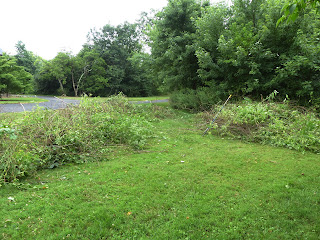
With iNaturalist down - they say "iNat will be back on its feet/wings/fins/tentacles/pseudopodia as soon as possible" - I'll dip into one of my other pictures for today's topic. Like many places, Duke Farms has invasive plants that they'd prefer to replace with native ones. One of my volunteer assignments - Trail Steward - is involved in cutting back some of these plants. Though plants like Japanese Honeysuckle , Japanese Barberry , Burning Bush , and Wineberry get a fair amount of attention, Multiflora Rose is frequently our main target. Although sometimes we've replanted other stuff after removing the invasive ones, many times we just cut the invasives down and hope it gives other species the opportunity to replace the invasive ones. Below is a picture of some of the invasives back in July. My impression is that these get hauled to a part of the property closed to the public, and after getting good and dried out they mulch it up. The mulch is then used to ...

Japanese Barberry in Autumn

Image
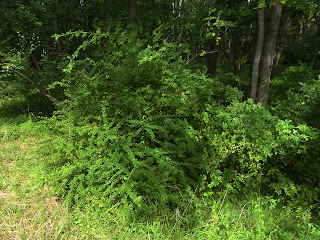
Here's an old invasive adversary of mine, Japanese Barberry , from late last autumn. Most of the year this bush is green, it eventually turns orange or red as cold temperatures arrive (though it does this later than most native plant rivals). This short video tells the story of how a garden shrub so effectively takes over an ecosystem. It's believed that the Japanese Barberry is tick-friendly because its dense branches/leaves provide an unusually humid environment that wards off the desiccation ticks typically face while looking for a host animal. And the thorniness of Japanese Barberry protects the mice that ticks prey on too, providing a convenient food source for the ticks. It's unclear just how much Japanese Barberry has increased Lyme Disease, though it's almost certainly helped this disease spread. Although Japanese Barberries do produce berries that birds eat, it does appear that birds avoid it until other berry sources are depleted. I've heard (though wasn...

Battle of the Invasives

Image
Forget about Alien vs Predator , we have two aggressive invaders that battle it out throughout much of NJ: In one corner, from the wilds of China, Korea, and Japan, an especially thorny rose introduced as "the living fence", we have Multiflora Rose . In the other corner, also from Japan and eastern Asia originally introduced as an ornamental shrub and that provides a haven for ticks, we have Japanese Barberry . These are 2 of the most common and aggressive invasive shrubs [1] in this area. Some places may be dominated by one or the other, though a lot of times you'll see both plants crowding out our beneficial native plants.  At Washington Valley Park I saw the pair of shrubs both fighting for basically the same spot. At a glance you might not even recognize there are 2 separate plants here. Multiflora Rose and Japanese Barberry August 3, 2021 at Washington Valley Park Photo 149026850, (c) jpviolette, some rights reserved (CC BY-NC) As you get closer, you can see the vici...