Posts

Showing posts with the label batesian mimicry

Snowberry Clearwing Moth

Image
Here's something I'll usually see a couple times during a summer, a Snowberry Clearwing Moth . I've shown this moth before , but they're always a welcome sight. Like hummingbird, butterflies, and moths like their Hummingbird Clearwing Moth cousins, they're helpful pollinators, colorful, and dynamic fliers.  They're also a good example of Batesian mimicry , where an essentially harmless animal has evolved to look like a more dangerous one. In the case of the Snowberry Clearwing Moth, they want you to think they're bumblebees . If you see one, you might want the scream "Ack! A bee!" and look frightened; the Snowberry Clearwing will experience the joy you get when a plan is working perfectly. September 8, 2022 at Fairview Farm Photo 248397240, (c) jpviolette, some rights reserved (CC BY-NC)

Margined Calligrapher Fly

Image
Here's a small fly that's generally considered beneficial, the Margined Calligrapher . (Or maybe I should say  Margined Calligrapher . ) Similar to their Eastern Calligrapher cousins, they are hover flies that mimic bees to appear more dangerous than they actually are. As adults they're harmless pollinators, though in their wild and crazy youth they were known to attack small invertebrates like aphids. Usually the little tip at the end of the abdomen has more black on it. I've read that some relatives will look lighter if it was warm during their pupal stage; perhaps this fella pupated during a warm stretch? June 8, 2022 at Duke Farms Photo 209834396, (c) jpviolette, some rights reserved (CC BY-NC)

Halloween Pennant

Image
Here's another Halloween Pennant . You can see the orangish wings that give this pennant its Halloween name. Not all dragonflies like to perch on the top of narrow vegetation, but it's a favored location for pennants. It's probably a little uncomfortable getting 6 legs on/around such a small perch, but probably offers the pennants the most different directions for flying off the perch, either to escape a predator or to attack as a predator. Some entomologists think the orangish coloring and a more erratic flight pattern than most dragonflies make the Halloween Pennant a mimic of the Monarch butterfly. This would be another example of Batesian mimicry , where some predators might pass the dragonfly by because they mistake it for a foul-tasting Monarch. I'm not sure the resemblance is close enough to fool most predators, though I suppose if a predator got only a quick look they could mistake the 2 insects. July 28, 2021 at Sourland Mountain Preserve Photo 148655861, (c)...

One Species, Two Morphs

Image
Sometimes members of the same species can look quite different, usually due to sexual dimorphism. For the female Eastern Tiger Swallowtail though, butterflies of the same sex can also look very different. Here is the dark morph of the Eastern Tiger Swallowtail. All dark morphs are females, and this morph is usually seen later in the season, August and onward. It actually has the underlying pattern that the yellow morph Eastern Tiger Swallowtails (see below) has, but instead of a black-on-yellow pattern the dark morph is more like a dark-black-on-light-black pattern. The dark morph is considered to be participating in Batesian mimicry , since they resemble the poisonous Pipevine Swallowtail . July 28, 2021 at Sourland Mountain Preserve Photo 148654982, (c) jpviolette, some rights reserved (CC BY-NC) I didn't see a yellow morph female Eastern Tiger Swallowtail on this trip, but the yellow morph female Eastern Tiger Swallowtail looks fairly similar to the males. They're yellow-an...

Eastern Calligrapher

Image
Meet an Eastern Calligrapher , an insect I probably haven't shown you before. (At least I hope it's an Eastern Calligrapher; some of its relatives look similar.) Eastern Calligraphers are part of a very large group of insects sometimes called hover flies (the males will hover around, either defending a territory from other males or just hoping to get the attention of a female), sometimes called flower flies (the adults feed off of the nectar and pollen of flowering plants), and sometimes called  syrphid flies (pronounced SUR-fid, which appears to come from Greek and Latin words loosely meaning "descended from gnats"). These flies have a waspy look, are considered wasp mimics, and since they can't sting, they're a good example of Batesian mimicry . Notice though that as flies, they have only 1 pair of wings whereas wasps, bees, and most flying insects have 2 pairs of wings.  They're considered pollinators , though they're probably not as effective as...

Bumble Bee Mimic Robber Flies

Image
Here are a couple Bumble Bee Mimic Robber Flies I ran across a couple months ago. And while it may look like they had an argument and are disdainfully looking away from each other, they're actually mating. Although there could be exceptions, in general I believe flies (including robber flies), butterflies/moths, and true bugs tend to mate with the ends of their abdomens connecting, while with beetles, mantises, and grasshoppers the males mount the females. (Yes, I've seen a fair amount of "insect porn" out there - these guys are shameless.) These flies are a little unpopular in some circles because: We've been told we need to protect bees. These robber flies actually eat bees. (I suspect they'll eat bee relatives we tend to feel less empathy for, like wasps/hornets, unless the wasps/hornets are substantially bigger than our bees.) Note that I don't see enough robber flies that I believe they're having much of an effect on bee populations. My guess is ...

False Milkweed Bug

Image
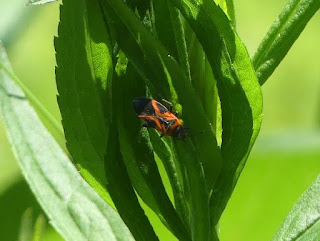
Here's a False Milkweed Bug I met a couple months back.  These guys have aposematic coloring but in their case it's misleading. As insects without a strong physical defense and that's not poisonous, they are advertising that they're dangerous to eat even though they're not. What they do have going for them is they look like (and are actually related to) the poisonous Large Milkweed Bug (a very common bug around me) and the Small Milkweed Bug (which is less common but looks even more similar to the False Milkweed Bug). This is called Batesian mimicry , basically impersonation a dangerous species when you're not dangerous. I don't think False Milkweed Bugs have been studied enough to know why they look the way they do. Did they evolve their red coloring so they'd look like their poisonous cousins? Or did their ancestors eat milkweed, develop their red coloring, and then evolve to eat a non-milkweed diet? Interestingly the Large Milkweed Bug eats exclusiv...

Common Eastern Bumble Bee

Image
I think this is an Eastern Common Bumble Bee . At least one person on iNaturalist agreed with this identification, it looks plausible, and this is considered to be one of the most common (hence in name) of our bumble bees. Bumble bees are sometimes confused with other insects like honey bees or carpenter bees or bumble bee mimics like the Snowberry Clearwing Moth and some hover flies. While honey bees and carpenter bees are obviously related, flies and butterflies are basically just trying to look like someone who can sting you ( Batesian mimicry ). Though their hive-dwelling honey bee cousins get a lot of the love and attention, technically they're an invasive species (albeit an important one for agriculture/horticulture). If you're trying to support native wildlife, supporting our native bumble bees is an excellent start. I'm thinking that the brown mass on the back leg is a pollen basket , the way that a bumble bee can transport pollen back to its nest. August 16, 2020...

Large Milkweed Bug

Image
Here’s a Large Milkweed Bug I met. Around me, this is probably the most common milkweed-eating insect other than aphids (and the aphids are so small you might mistake them for a rust or other fungus). They can be confused with the Small Milkweed Bug or the False Milkweed Bug . Both lack the straight black bar across the top of its wings, and the latter isn’t found on milkweeds (which are poisonous to many animals). Note the orange/red on these bugs. Like Monarch butterflies, these insects eat the poisonous milkweeds and obtain a certain amount of poisonous protection for themselves. And the distinctive red coloring signals to predators that these guys aren’t good to eat. (Of course, sometimes orange/red coloring is a fake. AFAIK the False Milkweed Bug is safe to eat, and benefit from Batesian mimicry .)