Posts

Showing posts with the label pruinose

Pair of Male Dragonflies

Image
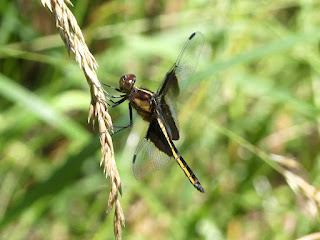
These were pretty good pictures of a couple of our more common dragonflies. (I've talked about these dragonflies plenty of times before, but who doesn't appreciate a photogenic dragonfly?) Although both are males with much of the field marks of mature males, there's at least an inkling that they're slightly immature. If they're not mature enough to be out competing for the attention of lady dragonflies, they're really close. The 1st is a Widow Skimmer with wings that are black near the base, followed by a contrasting vivid white, then going clear (albeit with some veins) the rest of the way out on the wings. What I don't see though is white pruinose on the abdomen like you can see in the mature male in this picture . June 17, 2023 at Duke Farms Photo 301010507, (c) jpviolette, some rights reserved (CC BY-NC) Next is an Eastern Pondhawk . Similar to the Widow Skimmer, you can tell the immature males from the mature ones based on pruinose, though in the case...

Great Blue Skimmer

Image
Here's yet another blue dragonfly, a Great Blue Skimmer  (in the proud footsteps of the Blue Dasher , Eastern Pondhawk , and Slaty Skimmer ). Although I've shown one of these before, that was likely a juvenile and really didn't show the blue that inspired their name.  IMHO this is a dragonfly that, especially when seen at a distance where size is difficult to determine, could be confused with the previously mentioned Blue Dasher. They're both dragonflies (as opposed to damselflies), the males have a light blue pruinose , they have small black stigmas on the front of their wings, and they have white faces. Here are some differences: Great Blue Skimmers are much larger dragonflies. Individuals vary in size, but you can expect Great Blue Skimmers to be between 20% and 120% bigger than Blue Dashers. (Side by side, you'd easily be able to tell them apart.) On most Blue Dashers, their pruinose doesn't extend all the way to the end of their abdomen, leaving the tip lo...

Maturing Eastern Pondhawk

Image
Though this picture isn't as sharp as I'd like, it does illustrate something interesting. It's a male Eastern Pondhawk that's about halfway through getting their blue pruinose . I've shown you what mature males look like compared to immature males and all females. This fella has an almost completely blue abdomen, a slightly blue thorax, but also shows the bright green coloring that juvenile males and all females have. As a reminder, pruinose is a waxy secretion despite frequently giving a dusty appearance. Though more common on males, older females of some species will also have it. It's not something every odonate has, but skimmers (like the Eastern Pondhawk) commonly have it. Pruinose can change the appearance of odonates quite a bit, like this Eastern Pondhawk changing from a bright green to more of a sky blue. I'm not sure when they start defending territories and looking for females, but if it hasn't happened yet it'll be happening soon. July...

Female Blue Dasher

Image
I see lots of male Blue Dashers but see females less frequently. I think this is a female. Certainly there's no pruinose , the eyes are brown rather than the blue-green of adult males, the end of the abdomen doesn't appear to have "claspers" [1], and the abdomen looks shorter than I usually see on Blue Dashers. Of course, immature males can have reddish-brown eyes and lack pruinose while claspers can be a little hard to see and abdomen length is a somewhat subjective field mark. For contrast, here's one that I convinced myself to be an immature male. I'm not sure why I see so many presumably male Blue Dashers and relatively few females, though the territorial nature of the males is presumably a factor. Rather than spending almost all their time eating prey and hiding from predators until they're ready to mate like the females, the males aggressively defend territories near water where I know to look for them. Perhaps while the females are discreetly chow...

White Blue Dasher?

Image
Here's a Blue Dasher  (don't call me White Dasher!) despite not looking especially blue. While it's possible that the dragonfly's abdomen would look a little bluer in different lighting, it's not uncommon to see Blue Dashers that are such a light blue that you might consider them to be white instead. Like many male dragonflies, they start out the adult, winged version of their lives looks a lot like females of their species, in this case having an abdomen that's yellow with black stripes. As the males mature, their abdomen starts to develop a dark blue pruinose (a waxy covering). And then as they age, the pruinose gets lighter and lighter. I'm thinking this guy is a Blue Dasher senior citizen given the lightness of this abdomen. One tricky thing about identifying species is that sometimes the names don't make a lot of sense given the individual you're looking at. This is especially true for female odonates, and frequently true for female birds, but s...

Eastern Pondhawks

Image
Let's show two of these guys today. They are a pair of Eastern Pondhawks I met about the same time a couple months back. The blue one is certainly a male. The green one is probably a female, though juvenile males of this species look an awful lot like females. As with many dragonflies, as the males age they become covered with pruinose, especially on the abdomen, but in Eastern Pondhawks you'll also see this on the thorax. In some species the pruinose is mostly white (like in Common Whitetails and Widow Skimmers), but in Eastern Pondhawks it's light blue. So while there's quite a bit of sexual dimorphism in mature Eastern Pondhawks, there's almost no sexual dimorphism amongst the juveniles. Finally, while it's possible that these 2 crazy kids might be a couple and have larvae together, it's at least possible the green one will eventually be a blue rival of the already-blue pondhawk. Presumed female Eastern Pondhawk June 17, 2021 at the Plainsboro Preserve P...

Widow Skimmer

Image
Here's another Widow Skimmer dragonfly I met. If dragonflies were more cooperative photography subjects, I'd probably try to get a picture like this plus a spread-wing picture from above the dragonfly. This angle gives me a pretty good look at the eyes/face/thorax/abdomen, but it's harder to use the wings as identification here. Having said that, I suspect this is a young male. Though the abdomen coloring is consistent with a female, I think I see a little pale white on the wings. If so, that's probably the male's pruinose just starting to come in. June 17, 2021 at the Plainsboro Preserve Photo 141957941, (c) jpviolette, some rights reserved (CC BY-NC)

Eastern Pondhawk

Image
Here's a youngish male Eastern Pondhawk I met earlier in the year. The males and females start life looking as pretty similar primarily green critters, but as they mature the males get covered in a light blue pruinose. You can still see a little green on this guy's abdomen; I think that'll eventually go away. The green on the thorax will probably be there for life. This was my first photo of this species of 2021, though they're pretty common and since then I've gotten lots of other pictures of them. Fun Fact: The Eastern Pondhawk isn't a hawk at all! They're actually dragonflies! 😉 June 10, 2021 at Duke Farms Photo 136369702, (c) jpviolette, some rights reserved (CC BY-NC)

Twelve-spotted Skimmer

Image
Meet another Twelve-spotted Skimmer . I previously showed you a juvenile male with almost no pruinose on its tail; here I'll contrast them. Both pictures were taken at the same place on the same day. First, here's another look at the juvenile. Note the dark tail. Juvenile male, August 15, 2020 at Negri Nepote Native Grassland Preserve And here's the mature male. Note the mostly-white tail. Mature male, August 15, 2020 at Negri Nepote Native Grassland Preserve

Juvenile Twelve-spotted Skimmer Dragonfly

Image
Here's a Twelve-spotted Skimmer . As you probably guessed, they are another dragonfly species in the skimmer family . They're named after their twelve black spots (3 black spots per wing). Coupled with the 2 white spots on each wing plus some basal white on the back wings, no other dragonfly around here looks like this, making the males one of the easiest dragonfly identifications around. The females look similar to this except the white spots aren't there; the wings are clear there instead. Since both males and females have the 12 black spots, you could argue that this is one of the few dragonfly common names influenced by the appearance of the female. (Based solely on the male, you could call it a Twenty-two-spotted Skimmer.) Though the white spots indicate this is a male, I see no pruinose on the tail, so I believe this is a young male. August 15, 2020 at Negri Nepote Native Grassland Preserve

Male Blue Dasher

Image
Meet a male  Blue Dasher Dragonfly . Tomorrow I'll show you a female. Like many other dragonflies in my area, they are also in the skimmer family . (Remember that this includes dragonflies like the pondhawks and meadowhawks in addition to ones actually named skimmers. At the Skimmer Family reunion, little nametags would no doubt be helpful because there's too many of these guys to remember them all.) On the other hand, there's no other dragonfly species in their genus, so the Blue Dasher has no really close relatives. The turquoise eyes and light blue tail make these guys fairly distinctive-looking. Like with many male dragonflies, the tail starts out a different color but develops a pruinescent waxy coating as they age. In Blue Dashers (and Eastern Pondhawks), the pruinescence is light blue, but in Common Whitetails and Widow Skimmers it is white. You can still see some of the original dark-blue tail color at the end of the tail of this individual. The other name for thi...