Posts

Showing posts with the label orange sulphur

Butterflies Mistaken For Moths

Image
Here are a couple of butterflies without fancy patterns or flashy colors that occasionally are mistaken for moths . They are a Clouded Sulphur and a Cabbage White , which are in the white and sulphur genera respectively, and both of which are in the same family of butterflies .  As smallish and somewhat plain-looking butterflies, you might not be surprised to learn they're somewhat related. The female Clouded/Orange Sulphurs can look virtually white, making the family resemblance even stronger. While I'm treating butterflies and moths as different groups under the lepidopterans , they're not exactly radically different groups. It's certain that butterflies evolved from moths ( when and why discussed here ), and so there's some reason to consider butterflies to be a subset of moths. This isn't too different from the people who consider birds/dinosaurs to be types of reptiles [1]. June 15, 2023 at Sourland Mountain Preserve Photo 300993980, (c) jpviolette, so...

Sleepy Orange - Pioneer Butterfly

Image
Here is a butterfly that's moved into the area fairly recently, the Sleepy Orange . Presumably within the last 10 years, some adventurous pioneer butterflies flew northward and found a home at Duke Farms. AFAIK they aren't yet found elsewhere in Somerset County, though there is now a healthy and robust population at Duke Farms that it seems like only a matter of time before they'll colonize other parts of the county and state [1]. They are (generally) similar to but smaller and more vibrant than their Orange Sulphur cousins. Though they're probably the sulphur butterfly I saw the most at Duke Farms this year, they were only 3rd during our butterfly count. (Other sulphurs were spotted a lot in the Community Garden and the Skeet Shoot/Duchess Farm parts of the property.) When their wings are open (not their typical resting position), their yellow-orange wings framed with near-black around the edges really can be fairly striking. July 28, 2022 at Duke Farms Photo 22206704...

Clouded Sulphur

Image
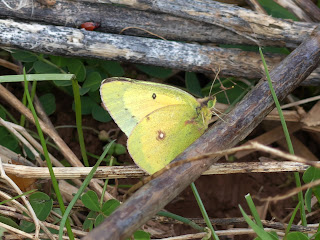
I posted about a questionable Clouded Sulphur in the past; I'm more confident of this one. This individual has the less ambiguous pale yellow color I'd associate with the Clouded Sulphur , and without the slightly orange or vibrant yellow I'd expect to see in their Orange Sulphur cousins. The picture was taken in mid-November, probably not the best time to be a butterfly. Certainly there aren't the nectaring opportunities found in the summer, and there aren't as many prospective mates around either.  November 17, 2021 at Duke Farms Photo 170812868, (c) jpviolette, some rights reserved (CC BY-NC)

Sleepy Orange Laying an Egg?

Image
I suspect I took this picture of a Sleepy Orange butterfly that was moving around a lot. It wasn't until I got around to getting a close look at the picture that I think I see something interesting about it. First, the leaves look like the Wild Senna that's fairly common at Duke Farms. And Wild Senna is one of the legumes that Sleepy Oranges (and some other sulphur butterflies ) use as host plants. And finally, the butterfly seems to be positioned a little unusually with the end of the abdomen touching the underside of a leaf. Put all these together, and I'm fairly sure this was a female Sleepy Orange laying eggs on the Wild Senna plants. If this culminated in an adult butterfly (predation is a challenge for most species), I suspect it'd have migrated south since Sleepy Oranges aren't believed to be able to overwinter here in NJ. (Note that some of its relatives like the Orange Sulphur and Clouded Sulphur can overwinter up here.) July 24, 2021 at Duke Farms Photo ...

Baby Cloudless Sulphur

Image
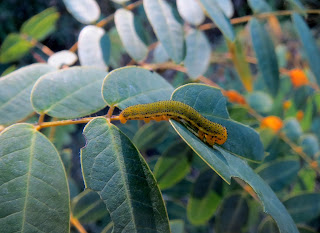
Here's a baby (caterpillar would be more conventional terms) Cloudless Sulphur . I took this picture over 4 years ago and didn't know what it was. This morning when I logged into iNaturalist, it had an ID of Cloudless Sulphur. I then looked that up in my Caterpillars of Eastern North America , and agreed that this was indeed a Cloudless Sulphur caterpillar. You might ask why I didn't just use my caterpillar field guide in the first place: I'm not sure I owned the field guide back in 2016. I wasn't sure this was a caterpillar. Some of the larvae of flies and wasps look pretty similar to moth/butterfly caterpillars. My field guide has over 400 pages of caterpillar species in it, and flipping through them all is either a very slow process or a fairly error-prone process. Despite all those caterpillars in the field guide, it's not complete.  My field guide did show me a picture of the Clouded Sulphur caterpillar, so I was able to rule that out as a candidate. It did...

Clouded Sulphur or Orange Sulphur

Image
Here's a sulphur who was living in my neighborhood. It's either a Clouded Sulphur or an Orange Sulphur . As I've mentioned before, these are very similar butterflies can be difficult to distinguish . While the top view of the Orange Sulphur's wings usually look orangish-yellow, that effect isn't as prominent on views of the bottom of the wings. I think this one is pale enough to be a Clouded Sulphur, but the identification hasn't been endorsed (or refuted) on iNaturalist ; I suspect the coloring is in that inconclusive area. I've also warned you in the past about relying too heavily on color. All too often lighting can play tricks on what a camera produces. Unfortunately the markings of these two butterflies is close enough that color/shading really is the best way (short of a DNA test) to distinguish them. Technically these two butterflies will hybridize occasionally, it doesn't sound like it happens often. And given how similar these species are, the ...

Sleepy Orange

Image
Here's a Sleepy Orange butterfly. This butterfly is one of the sulphurs , and in my area is probably the 4th most common butterfly in the subfamily. It's one of two butterflies that are easily confused with the Orange Sulphur due to similar coloring; the Sleepy Orange is probably only slightly more vibrant and has different markings. By comparison, the Clouded Sulphur is slightly less vibrant than the Orange Sulphur but with virtually identical markings. (The Clouded and the Orange Sulphurs can hybridize. As far as I know, the Sleepy Orange cannot hybridize with either of the others.) We also have Cloudless Sulphurs in my area, but they're less likely to be mistaken for the others because they're both larger and paler. After these 4, I haven't encountered any other sulphurs around here, but these 4 species combine to make mostly-yellow butterflies a very common sight. Up until about 3 years ago the Sleepy Orange hadn't been found in Somerset County, but the ...