Posts

Showing posts with the label red admiral

Blue and Admiral

Image
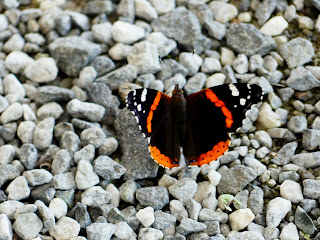
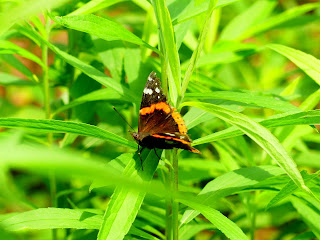
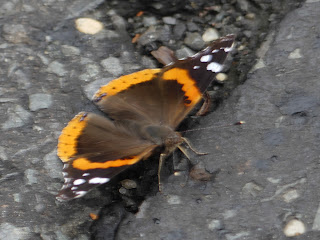
Here are a couple butterflies I saw last summer that don't have a lot to do with 1 another, but were both too photogenic not to share. The first is another Red Admiral butterfly while the 2nd is an Eastern Tailed-blue . Since I don't see a hint of violet/blue on the top of the wings of the Eastern Tailed-blue, I'm pretty sure this is a female butterfly; here are some males for contrast. (AFAIK there isn't an easy way to tell the gender of Red Admirals ... though the butterflies themselves do it pretty routinely.) June 24, 2023 at Duke Farms Photo 301212473, (c) jpviolette, some rights reserved (CC BY-NC) June 24, 2023 at Duke Farms Photo 301212623, (c) jpviolette, some rights reserved (CC BY-NC)
Mourning Cloak Views

Image
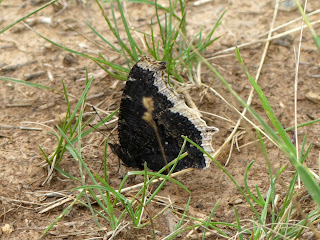
While immature and sexually dimorphic species can look different (see Common Whitetails and Eastern Pondhawks ), sometime butterflies like the Mourning Cloak can present a different look just by repositioning its wings. (Other species that can do this include - but are not limited to - Red Admirals and Question Marks .) The 1st picture is their camouflage look, and while it doesn't blend in too well in this sandy soil, it can be quite a bit harder to spot them in leaf litter or against the bark of some trees. Though there's a light colored trim at the edges, they resemble something drab with a rough texture. June 15, 2023 at Sourland Mountain Preserve Photo 300991453, (c) jpviolette, some rights reserved (CC BY-NC) But then the butterfly opened its wings, allowing us a view of its rich brown wings with light spots highlighted by a black background and with almost a gold trim on the edges. And the wings that appeared to have a rough texture with the wings up suddenly seem to...

Spring Preview - More Red Admirals

Image
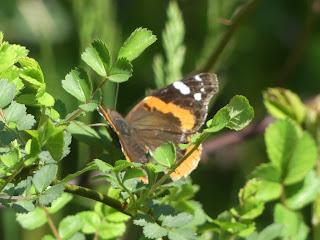
There were apparently a fair number of Red Admiral butterflies out and about last spring. And take heart, the days are getting longer, we're only days away from getting a springtime ruling from a rodent [1], and soon butterflies and their warm weather friends [2] will start showing up. May 26, 2023 at Duke Farms Photo 300288105, (c) jpviolette, some rights reserved (CC BY-NC) May 26, 2023 at Duke Farms Photo 300288188, (c) jpviolette, some rights reserved (CC BY-NC) [1] I can only assume Groundhogs are in their burrows, pouring over meteorological data, and running their weather forecasting programs preparing their forecast. Those little guys are under a lot of pressure this time of year. [2] Admittedly butterfly enemies will also start emerging.
Red Admirals Basking in the Springtime Sun

Image
If you're an ectotherm like these Red Admirals (or an Northern Red-bellied Cooter ), nothing warms your heart like sunlight. Be careful about lumping all lepidopterans into the ectothermic camp though; some winter moths are actually considered endothermic . Back when I was a kid we were taught that all birds and mammals were endotherms and every other animal was some sort of ectotherm, which is a mostly-but-not-entirely true simplification. Red Admirals though do fall squarely into the ectotherm camp; they're not someone you'll meet in the winter. Note that these butterflies look fairly different, with the 2nd picture having faded coloring and somewhat ragged hind wings. It sounds like Red Admirals can brumate as adults, so it's possible that the 1 in the 2nd picture survived the winter while the 1 in the 1st picture may have emerged from its chrysalis within the last month. Remember, they got the "admiral" part of their name because they were admired , not...

Red Admirals

Image
Relatively shortly after getting my 1st pictures of the season of early-emerging Mourning Cloak butterflies I got pictures of a prime time butterfly commonly seen in warmer months: a pair of Red Admirals .  Seeing this butterfly in April seems a little unusual. My understanding is that although they can hibernate in warmer parts of the country, they're not supposed to be able to do it in New Jersey where the winters are considered too cold for them. I guess I'm left with 2 theories: Maybe they can hibernate fairly close to New Jersey (Delaware/Maryland/Virginia?) and simply migrated north from there earlier than they usually do. Our winters "ain't what they used to be"; is it possible there's a population of them that's now able to hibernate through our winters? While the former theory seems more plausible, as the climate changes there will obviously be changes to our environment. And heavily mobile species like birds and butterflies are better positioned ...

Contradictory Looks of the Red Admiral Butterfly

Image
This post demonstrates the extremely different looks that Red Admiral butterflies can present to the world. (Being fairly common yet attention-getting, I've shown them before, like here and here .) Today I want to demonstrate how they can (not so magically) disappear. The trick is in the color pattern of the top and bottom of their wings. When you see the tops of the wings, you see a mostly-black butterfly with vibrant orange lines and sharply contrasting white spots. July 5, 2022 at Duke Farms Photo 221312289, (c) jpviolette, some rights reserved (CC BY-NC) But when it raises its wings, abracadabra, it's disappeared! Okay, it hasn't quite disappeared, but it sure blends in with a dirt-stick-leaf background, doesn't it? July 5, 2022 at Duke Farms Photo 221312326, (c) jpviolette, some rights reserved (CC BY-NC) Although not closely related to the Red Admiral, our Eastern Comma and Question Mark butterflies also have earthy-looking underwings. Sometimes I'm follow...

American Copper

Image
Since I've been showing Great Spangled Fritillaries this week, for Throwback Thursday let's dip into the photography archives to show a cool-looking butterfly from the past, an American Copper  (aka Common Copper). While the name might make you think I'm talking about a member of a US constabulary , the coppers are a subfamily of generally small butterflies. Though one source claimed they are an introduced species, most sources suggest it's more of an international butterfly than an invasive one. Similar to the Red Admiral and Painted Lady , it appears to be native to not just North America but also Eurasia and much of Africa. Though the species may be found across much of the world, its numerous subspecies tend to be more localized. Though it's a fairly colorful butterfly it's easy to overlook due to its diminutive size. If you're familiar with the Spring/Summer Azures , they're approximately that size. When I got my pictures, I wasn't sure what ...

Red Admiral

Image
For at least 3 weeks now I've been seeing Red Admirals around. These are butterflies that don't have the long, regular migration cycle of the Monarch butterfly ; instead they basically migrate south when their caterpillar host food - nettles - is no longer available as winter sets in. And then in the spring as we get our nettles back, the Red Admirals migrate north to take advantage of the food source. Don't confuse the Red Admirals with the Red-spotted Admirals ; despite the similar name these are 2 different species that don't even look alike. I talked about Red-spotted Admirals here , and talked about Red Admirals here . These butterflies are fairly common, and if you're in woods and meadows a lot you're likely to run across them. They're considered more human-tolerant than most butterflies. They'll sometimes even land on you, though this is probably about them trying to drink up some sweat than it is raw friendliness. June 2, 2022 at Duke Farms Pho...

Tattered Red Admiral

Image
Here's a Red Admiral butterfly that looks like it could win a tattered wing contest. I'd like to think the butterfly has some harrowing and exciting stories to tell like in the scar comparisons in Jaws : This tear here, I got that shortly after pupating. A starling got the end of my right wing in its beak. I'd have been a goner, but when the starling was focused on me, that hawk came down on the starling. I lost part of my left rear wing when that praying mantis grabbed at me. If he'd have gotten my abdomen instead of my wing, I wouldn't be talking to you here today. The rest of that wing I lost in the web of a spider. If it hadn't been torn already, I'd never have been able to escape that web before that spider got to me. That one there, a robberfly had me for a second, but let go when that starling appeared and ate the robberfly. Funny how sometimes a starling saves you and sometimes tries to eat you. And this one got ripped when a dragonfly tried to eat ...

Red Admiral

Image
Here's a Red Admiral butterfly I met in late spring. As I suggested in an earlier post , a better name for them might be an Orange Admirable. (They were almost certainly named before we defined orange as a separate color from red, and "admiral" is probably a corruption of the term "admirable".) I've occasionally seen these butterflies together, but most of the time I see the lone Red Admiral. At least the males are considered pretty territorial, so seeing only one male in an area probably makes sense. This is a butterfly that will sometimes land on people. I suspect that they're males looking to drink up some sweat; this is another version of mud-puddling behavior . June 10, 2021 at Duke Farms Photo 136368803, (c) jpviolette, some rights reserved (CC BY-NC)

Red Admiral

Image
I met this Red Admiral butterfly at Duke Farms about a month ago. This is a little early for these butterflies who are more numerous later in the year. These guys migrate south to avoid our winters; it's likely that this guy was born down south and fluttered up to New Jersey as the weather warmed. The males stake out a territory and then fiercely defend it from other males. Of course, since they can't bite, scratch, or sting, fiercely defending a territory mostly consists of fluttering into their opponent as violently as possible. (My impression is that all females are welcome in their territory.) As caterpillars they're not picky eaters, eating most (all?) plants in the nettle family plus a smattering of other plants. This is probably why they live across North America, Eurasia, and North Africa, making it a fairly widespread species. May 4, 2021 at Duke Farms Photo 128324505, (c) jpviolette, some rights reserved (CC BY-NC)

Red Admiral

Image
Here's another  Red Admiral Butterfly I met. (These guys are fairly common, so you can expect them in more posts.) What's up with the Red Admiral name? It sounds like an antagonist in a Tom Clancy novel, but apparently their name used to be "Red Admirable", and the "admirable" got corrupted into "admiral". Apparently this is also true of other admiral butterflies . This brings up a potentially confusing thing about their name. There is a genus of admiral butterflies (local members including the Red-spotted Admiral and the Viceroy), but the Red Admiral is not in this genus; Red Admirals are actually ladies (like the Painted Lady and American Lady ). When is an admiral not an admiral? When it's a Red Admiral. (Admirals and ladies are both brush-footed butterflies though, so they are sorta related.) You could also ask why this isn't called an Orange Admiral. Well, the Red Admiral is a species native to Eurasia, and probably got named before...

Red Admiral Butterfly

Image
Here's a Red Admiral Butterfly we spotted at the 2020 Duke Farms butterfly count. This is a very widespread species of butterfly, living in much of North and South America, Europe, Asia, and some of Africa. Though the British consider them to be large butterflies, I'd put them in more of a medium category. Like most butterflies/moths, they can only be as widespread as their host plant(s), and the Red Admiral uses most plants in the nettle family . In my area, a common (though not entirely popular) nettle is the Stinging Nettle , and a lot of times you'll see them in the vicinity of this skin-irritating plant. This is a butterfly that might land on you. They don't bite, but the salts in your sweat is an important nutrient for these butterflies. Consider letting them drink; you weren't using that sweat anymore anyway. July 25 at Duke Farms