Posts

Showing posts with the label shorebird

Not-so-solitary Solitary Sandpipers

Image
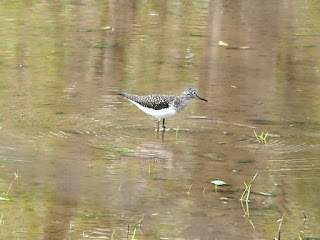
Last spring I saw a number of shorebirds , most of them migrating through New Jersey to get to more northerly breeding grounds [1]. On this particular day I saw a couple of Solitary Sandpipers in the same general vicinity at the same time. Although they get the "solitary" part of their name because they're frequently found alone, during migration there are probably only a limited number of good way stations available along their route. It's not shocking to see them and/or their larger Lesser Yellowlegs and Greater Yellowlegs cousins working the same area of a river even if they're not purposely flocking together. Solitary Sandpipers may prefer their alone time, but they're not psychopathic about it; these 2 were working different parts of Dukes Brook without any hostility that I could see. May 3, 2023 at Duke Farms Photo 278556645, (c) jpviolette, some rights reserved (CC BY-NC) May 3, 2023 at Duke Farms Photo 278556715, (c) jpviolette, some rights reserve...

Greater Yellowlegs

Image
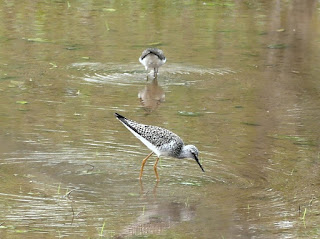
This picture was a little obscured by vegetation, but it's my 1st verified Greater Yellowlegs of the season. They are sandpipers , a large family of shorebirds [1]. Their closest relatives in my area are the smaller Lesser Yellowlegs and the Solitary Sandpiper , with all 3 being in the Tringa genus . Though they are the largest of these 3 species, pictures like this 1 probably don't give a strong sense of size. You'll mostly tell them from the Lesser Yellowlegs because the Greater Yellowlegs has a noticeably longer beak relative to the head [2]. In the picture below, the bill certainly appears to be longer than the rest of the head. Similar to their Lesser Yellowlegs and Solitary Sandpiper cousins, I've only seen these birds during migration. They generally spend our winters south of here (some going as far as South America), though some maps suggest they might winter as far north as southern New Jersey and Long Island [3]. These birds should have started migrating b...

Killdeer at a Shore

Image
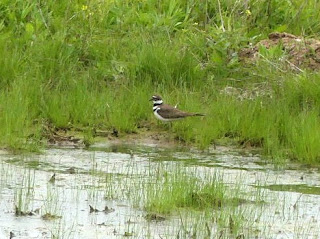
Although I frequently see Killdeer away from water, they are taxonomically shorebirds , so perhaps I shouldn't have been surprised to see one along the banks of a stream (Dukes Brook). I don't think they dislike the water, though they are fairly comfortable nesting and foraging away from it [1].  The Killdeer was spotted in April, a time when this area gets quite a few migratory shorebirds. While I'd like to think that the Killdeer was at the shore to socialize with these other shorebirds, having names like Solitary Sandpiper suggests to me that they're not the most social birds in the world. (On the other hand, it does sound like Lesser Yellowlegs will flock together, though whether that sociability extends to Killdeer is uncertain.) April 12, 2023 at Duke Farms Photo 272115395, (c) jpviolette, some rights reserved (CC BY-NC) [1] FWIW some other shorebirds seem to feel similarly.

American Woodcock

Image
Here's someone I didn't expect to see (and barely did see, as you'll be able to tell from my photo): an American Woodcock . I have to admit I'm not sure how these birds operate. They eat worms and other invertebrate from the ground, using their long beaks to explore under leaves and other debris. And they are apparently in NJ during the winter. But they're supposed to be susceptible to starvation if there's snow cover or temperatures that freeze the ground, so I'm not sure how they make it through a historical NJ winter. [1] They're known for the male's elaborate courting ritual , though that's more of an early spring activity. I'm skeptical I'd see that in December even if a male and female were in this area. Woodcocks are technically shorebirds , but that indicates who their relatives are, not how they live. Their closest North American relative is the Wilson's Snipe . Here's my picture of the little fella, surprisingly well ca...

Killdeer

Image
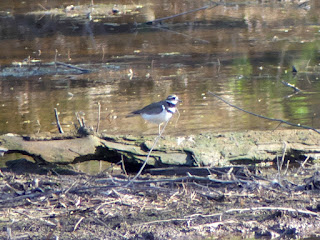
Here's a Killdeer I met last month. These guys (like the Solitary Sandpiper and the Lesser Yellowlegs ) are shorebirds ... but they are shorebirds that can take the shore or leave it. They seem to like flat areas, and I'm sure they've nested in the Murray Hills parking lot where I used to work. They lay their eggs on the ground and in the open. Though the eggs do look like smooth stones, their primary protection is probably the "broken wing defense". If a predator appears, a parent will utilize their thespian skills to fake being a bird who can't fly due to a broken wing. If all goes well, the predator won't find the eggs and will attempt to stalk the "injured" Killdeer. Once the Killdeer has lured the predator sufficiently far away, that broken wing will miraculously heal and they'll fly to safety. Here's a reenactment . Though I haven't heard them a lot, they get their name from their call that sounds like "kill deer". ...

Solitary Sandpiper

Image
Here's another migratory bird I met last month, a Solitary Sandpiper . Unless I'm misidentifying my shorebirds, these guys are probably one of the most common shorebirds to migrate through my area each year. Apparently these birds aren't often seen in flocks but are instead usually seen alone, hence the solitary part of their name. This particular one was foraging near yesterday's Lesser Yellowlegs , so they're not arch-isolationists. (Maybe they're just a little introverted?) These birds are more closely related to the Lesser and Greater Yellowlegs than they are to the other sandpipers, though the Solitary Sandpiper is noticeably smaller than its yellowlegs cousins. May 4, 2021 at Duke Farms Photo 128323676, (c) jpviolette, some rights reserved (CC BY-NC)

Lesser Yellowlegs

Image
Here's a Lesser Yellowlegs I met about a month ago. These guys don't live in New Jersey, only passing through during migration. They spend the winter in the area around the Gulf of Mexico and along the Atlantic Coast of the southern US, and breed in Alaska and northern Canada. A journey like that requires stopping off along the way, and this fella was nosing around Dukes Brook in hopes of a meal while resting those wings. I have to admit that, because they're only around here for a couple weeks during migration, I'm not particularly good at identifying them. Having said that, the Lesser Yellowlegs seems to be a fairly common shorebird to see around migration. May 4, 2021 at Duke Farms Photo 128323470, (c) jpviolette, some rights reserved (CC BY-NC)