Posts

Showing posts with the label queen anne's lace

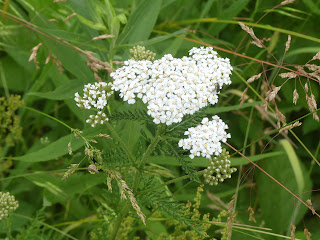
Common Yarrow

Image
Here's a Common Yarrow I saw last spring. I'd consider it a mid-sized wildflower, maybe getting 3 feet tall but frequently shorter than that. I personally think they look a lot like a completely unrelated wildflower, Queen Anne's Lace (the "wild carrot"). Both plants are mid-sized, and both have umbels of small white flowers. But there are differences: While both have pinnate (fern-like) leaves, Common Yarrow leaves are each more like a single fern while Queen Anne's Lace leaves comprise multiple fern-like leaflets. Queen Anne's Lace will usually have a red (or black if it's old enough) spot in the middle of the umbel. You'll usually see them at different points in the year, with Common Yarrow being most a springtime wildflower while Queen Anne's Lace is more of a summertime 1. I mentioned they're unrelated; Queen Anne's Lace is in the parsley/carrot family while Common Yarrow is in the aster/sunflower/daisy/composite family . Whil...
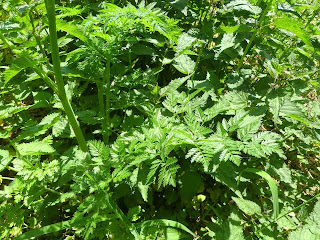
Poison Hemlock

Image
Here's some Poison Hemlock I met a couple months back. Poison Hemlock is interesting in a lot of ways: It's not native to North America. It's an invasive plant from Europe and other Mediterranean regions. Despite not being a native species, a native butterfly (the Black Swallowtail ) can use it as a host plant as a caterpillar. It's related to plants we can eat, like carrots, parsley, and celery.  Though Poison Hemlock is plenty poisonous, our native water hemlocks are considered even more poisonous. It was the way the ancient Greeks got rid of Socrates and other condemned prisoners. It's not related to the hemlock trees , which are pine trees with foliage that smell slightly similar to Poison Hemlock leaves. The trees aren't poisonous (though this isn't an endorsement to eat their bark or needles). I don't see a lot of Poison Hemlock around, but there are areas where it's doing pretty well. I've heard that people have eaten it thinking that i...