Posts

Showing posts with the label common snapping turtle

Turtles Painted with Vegetation?

Image
These Painted Turtles look like they've been painted with loose vegetation from the reservoir. I doubt it's a turtle fashion statement and is instead indicative of the vegetation growing in the water, though this does add a little color to mostly-dark turtles. I've certainly seen other messy turtles like this Spotted Turtle , and our Common Snapping Turtles are frequently seen carrying vegetation around . I suspect this is mostly harmless, though maybe it makes their basking in the sun a little less productive? I'd recommend they take a bath , but since they probably got this way swimming in this water, it probably wouldn't help. June 13, 2023 at Washington Valley Reservoir Photo 300987037, (c) jpviolette, some rights reserved (CC BY-NC)

Great Egret Striking a Pose

Image
Green Herons and Great Blue Herons weren't the only herons I spotted on this day; this Great Egret struck a pose as it waded over to its fishing spot. Since there's no taxonomic difference between herons and egrets, I'm going to claim that I hit the Heron Trifecta this day. Great Egrets are, anatomically speaking, slightly short and thin Great Blue Herons, and since the Great Blue Heron has virtually no avian predators [1], the same is probably also true of the Great Egret. If a coyote or bobcat caught 1 on land, my guess it wouldn't go well for the Great Egret. In the water, there are probably somewhat rare attacks by Common Snapping Turtles , though between scavenging and eating vegetation, snapping turtles usually find easier prey. May 25, 2023 at Duke Farms Photo 292819218, (c) jpviolette, some rights reserved (CC BY-NC) [1] It sounds like Golden Eagles will sometimes prey on Great Blue Herons but Bald Eagles rarely will. Since my area is largely devoid of Golde...

A Common Snapping Turtle Gets Down and Dirty

Image
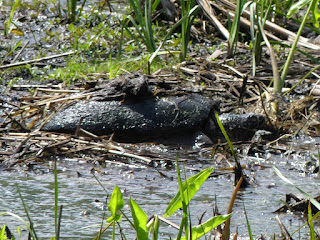
This Common Snapping Turtle came out of the muck of Great Swamp to bask with a piece of the swamp stuck to its back. Although it might make the snapping turtle feel a little more secure via a little  camouflage [1], gunk on the carapace does cut down on the sun rays it's able to absorb. I've certainly seen them basking further out of the water , though they spend more of their time in shallow water .  If humans were worrying the snapping turtle, it would probably be happy to hear that I wouldn't have noticed it if I wasn't scanning the area with my binoculars. With the naked eye, I doubt I'd have spotted it. (This is also how I spotted yesterday's Green Heron ; I have no idea if they're friends.) May 11, 2023 at Great Swamp Photo 282421749, (c) jpviolette, some rights reserved (CC BY-NC) [1] Adult snapping turtles don't have a lot of predators; similar to deer, their main predator these days might be the automobile. Still, while they have a fierce reput...

Eastern Musk Turtles

Image
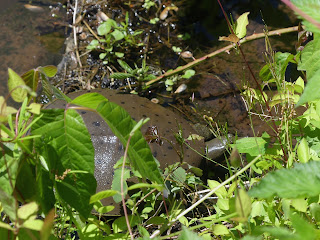
I met some turtles last spring that I don't see a lot: Eastern Musk Turtles . There were a few individuals lying around; these were 2 of the better pictures that I got. These turtles don't bask very often, and both of these seemed to be pulling the old Common Snapping Turtle trick of quasi-basking half in and half out of the water. I suspect they were only basking this much because it was still early May and they needed the extra sunlight to shake off their winter dormancy. Most of you probably would have found these turtles easier than I did since they're considered to be a smelly turtle [1], indicated both by the "musk" part of their name and their "stinkpot" nickname. Musk turtles and mud turtles are different types of turtle, but are in the same family . I encounter mud turtles even less frequently than their musky cousins. May 10, 2023 at Delaware Raritan Canal Photo 282315053, (c) jpviolette, some rights reserved (CC BY-NC) May 10, 2023 at Delaw...
Common Snapping Turtle or a Rock?

Image
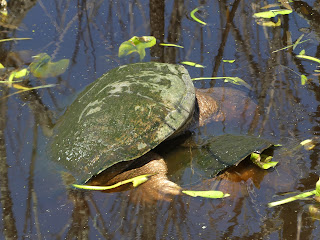
This Common Snapping Turtle surfaced long enough for me to get a picture. As has happened in the past, I initially thought I was looking at a rock, and I only kept looking there because I didn't remember seeing a rock in this location before [1]. And sure enough, the "rock" rose up higher in the water and showed its head [2]. Because of the tendency of Common Snapping Turtles to bask in the sun while mostly submerged with only the top of their carapace protruding out of the water, they're easier to mistake for rocks than pretty much any other area turtle. And of course, if a smaller turtle were to do this, it would also be easier to overlook them completely.  But even though our snapping turtles can look quite a bit like rocks while basking in this fairly unique way, they still like to breathe, and after several minutes you'll notice that at least the tip of the nose will poke above the surface, demonstrating that they're no rock after all. May 6, 2023 at Duk...

More Mating Snapping Turtles?

Image
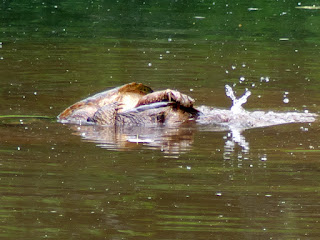
In June of 2022 I showed pictures of what appeared to be Common Snapping Turtles mating at Duke Farms. This past April I think I saw the same thing, this time at Great Swamp. At least it looked like a couple snapping turtles sloshing around together, usually with 1 or the other partially breaking the surface but with a lot of activity going on beneath the surface. While I can't completely rule out that this was some turtle fight, it seemed to go on for a while with neither turtle injured or trying to escape. Still, it's not always easy to understand the behavior of our animal friends, especially when water is obscuring part of the activity. April 13, 2023 at Great Swamp National Wildlife Refuge Photo 272119765, (c) jpviolette, some rights reserved (CC BY-NC) April 13, 2023 at Great Swamp National Wildlife Refuge Photo 272119838, (c) jpviolette, some rights reserved (CC BY-NC)  

Wood Duck Home

Image
For Throwback Thursday, I met a Wood Duck mom leaving her house back in 2017, presumably to make a food run. This is the only time I knew for sure that this duck box was occupied, and I was kind of fortunate the duck decided to leave when I was in the area. This box was obviously designed for a Wood Duck to nest in. Though she could get in and out fairly efficiently, a somewhat larger bird probably wouldn't have a chance of getting in. I'm a little torn on the choice of location though. When her ducklings are ready to leave the nest, it's a fairly short drop straight into water. On the other hand, I've certainly seen Common Snapping Turtles in this part of Great Swamp, and although I'm not sure duckling is their favorite food, snapping turtles will prey on waterfowl. And small, immature waterfowl probably makes their hunt especially easy. June 11, 2017 at Great Swamp National Wildlife Refuge Photo 8555584, (c) jpviolette, some rights reserved (CC BY-NC)
Spiny Softshell Turtles

Image
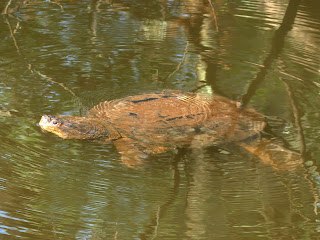
I found a trail near the intersection of South Bridge Street and Route 206 in Somerville. I think it's considered a part of the Raritan River Greenway that seemingly connects to the Peter's Brook Greenway [1]. I noticed some large turtles basking on the opposite side of the river, figured they were Northern Red-bellied Cooters , and followed a side trail to get a better look. As I approached (but still being across the river) most of the turtles scurried into the river. But a couple stayed on the riverbank, and they weren't cooters. They were a species I had only photographed once before at the Raritan Water Power Canal, Spiny Softshell Turtles . While my previous sighting gave me an impression of a smallish spotted turtle though, these turtles were large and (mostly) uniform in color [2]. Apparently young Spiny Softshells have spots, and some of the males retain those spots. This means my previous sighting was either young, male, or both. Interestingly, my Field Guide to ...

Common Snapping Turtle

Image
Here's a Common Snapping Turtle I met last September. This fella was swimming with its head out of the water so that even the underwater parts of the turtle photographed pretty well. It was at the Raritan Power Canal part of Duke Island Park, a habitat popular with many species of turtle [1]. While you may not think they're cute and cuddly, other snapping turtles disagree with that assessment . I talked a little about their relatives in this earlier post . And I talked about why they might be easier to spot at Duke Island Park here (hint: it involves food). September 16, 2022 at Duke Island Park Photo 248764345, (c) jpviolette, some rights reserved (CC BY-NC) [1] In my area, perhaps the best places to observe turtles are our 2 canals, the Delaware Raritan Canal and the (much shorter) Raritan Power Canal. Turtles seem to like the relatively calm water and plentiful basking opportunities there -and- the trails are close enough to the water that you can frequently get good looks...

Common Snapping Turtle

Image
Here's a Common Snapping Turtle I met last summer. Though they'll occasionally bask out on a log , they prefer to do semi-basking in shallow water with only their shell above the water line. Your best chance for a "head shot" is when they come up to breathe, which this fella presumably was doing. Though parts of the southern US have an Alligator Snapping Turtle , the closest taxonomic relatives of the Common Snapping Turtle are probably the Central American Snapping Turtle and the South American Snapping Turtle , both of whom used to be considered subspecies of the Common Snapping Turtle. August 23, 2022 at Duke Farms Photo 229694534, (c) jpviolette, some rights reserved (CC BY-NC)
North American River Otter

Image
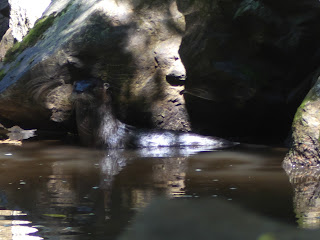
This was one of my favorite animals that I spotted this year, a North American River Otter . I believe it was on August 20 that I first glimpsed them at Dukes Brook. Unfortunately I couldn't wait around that day to get a picture because I was scheduled for a volunteer shift as an Outdoor Educator. When the shift was over I went back to the brook but was unable to find them again. (I suspect they had moved someplace quieter.) A few days later I was back and looked for them along Dukes Brook. The 1st 3 spots I checked showed no signs of them, but at my 4th spot along the brook I struck paydirt. At least 2 otters were romping in and out of the water, fitting since a romp is the collective name for a group of otters. River otters will mostly eat aquatic animals, including fish, crustaceans, reptiles, and amphibians. Waterfowl are also taken if they can get close enough. Muskrats are on the menu; reports vary about whether beavers are taken. My guess is that fully grown Common Snappin...

Awkwardly Basking Snapping Turtle

Image
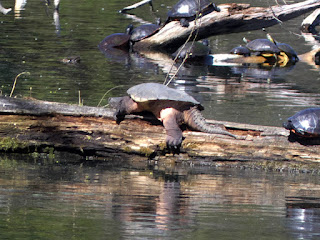
Here's another picture of a basking Common Snapping Turtle . As I've mentioned before, these turtles are infrequent above-water baskers , instead preferring to catch less sunlight while staying in the water. I tend to think they're really uncomfortable/insecure when out of the water (very much like the "fish out of water" euphemism); when they're out of water they have a reputation for being aggressive and bad-tempered, but in the water they're unlikely to snap at you unless directly threatened. When they do bask out of the water, they can look awkward and out-of-place. Here's one that I spotted on some wood projecting out of the water of a small pond. At the risk of anthropomorphizing this guy, doesn't it look like a shipwreck survivor clinging to jetsam while sadly hoping to be rescued? (Visually I'd like to offer it help, but intellectually I know it's just fine and wouldn't welcome any attempt to aid it.) June 10, 2022 at Negri Nep...

Breeding Snapping Turtles

Image
A couple weeks ago at the Dukes Brook bird blind at Duke Farms, I didn't see birds but saw "something weird" going on in the water. I'd see something large repeatedly emerge from and submerge into the water. It took a while for me to convince myself this was due to one/more Common Snapping Turtles as opposed to some odd largish fish ( European Carp ?) activity. Once I convinced myself this was snapping turtle activity, I still wasn't sure what was going on. Was a snapping turtle attacking something, either another turtle, or bird, or even something like a beaver or otter? Well, there was no sign of blood in the water, and given a snapping turtle's ability to inflict damage it seemed unlikely that one would be involved in a fight for any length of time without one combatant or another getting wounded. I'm now of the belief that I was seeing Common Snapping Turtles mating in the water, surfacing for breath and positioning. And I've heard that snapping t...

Basking Snapping Turtle

Image
I've mentioned that Common Snapping Turtles usually don't bask in the sun the way many turtles do, frequently choosing to warm up by finding a sunny place in shallow water where they stay almost entirely submerged. But there are exceptions. In the spring, perhaps in an effort to more quickly shake off the dormancy of winter, snapping turtles might do a little basking. And here's one that I caught in the act. Compared to other turtles, the Common Snapping Turtle almost looks too big/bulky for its shell. And they can't retract their heads into their shells like many turtles. April 22, 2022 at Duke Farms Photo 197660794, (c) jpviolette, some rights reserved (CC BY-NC) Although other turtles (none of them snapping turtles) were willing to share a log with the Common Snapping Turtle, they also kept a respectful distance from their larger cousin. I'm not sure how likely it would be for the Common Snapping Turtle to attack the others, though I'm sure turtle-on-turtle ...
Common Snapping Turtle (Extra Small)

Image
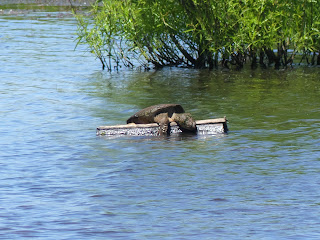
A couple of people were looking at something on the side of the road, and it turned out to be a small Common Snapping Turtle . At this size they're actually cute little guys, though my guess is they'd still be able to inflict a painful bite. (I didn't attempt to pick it up.) The turtle seemed to be heading in the general direction of a lake. Though it had a way to go, my impression is that it's best to let them get there on their own; they know their destination better than we do. I was somewhat surprised to see this little fella. My initial thought was that the turtle had just hatched and was making its way to water, but this theory has timing problems. Common Snapping Turtles tend to hatch 9-18 weeks after they're laid depending on temperature. I'm thinking that an emergence this time of year would imply closer to 18 weeks of incubation, pointing to eggs being laid in mid-December or early January. I'm not even sure a turtle mom could walk around outside t...

Snapping Turtles

Image
Here are a couple of Common Snapping Turtles I met back in August. I suppose you might find larger sea turtles out at the shore, but inland these guys are kings of the turtles, and considered a top predator in their ecosystems. They achieve this status despite being omnivores [1]. They do have a reputation for being aggressive, and they probably are fairly feisty if you encounter them on land where they presumably feel vulnerable and out of their element. It sounds like in the water though they'll usually just avoid humans. Duke Island Park has a building (mostly closed during the pandemic) where if you go around the back, it overlooks the Raritan Water Power Canal. This is where the snapping turtles were. (Someone claimed they show up because people feed them. Generally speaking, this isn't a good idea; us humans rarely feed animals food that meets their nutritional needs [2]. Admittedly it did help me get these pictures.) I thought the 1st snapping turtle to show up was pret...

Spiny Softshell Turtle

Image
Here's a Spiny Softshell Turtle I met back in May. When I saw the spots, I suspected this was a Spotted Turtle , but when I got home I realized that Spotted Turtles have yellow spots, not black. Eventually I read that the Spiny Softshell is sometimes spotted like in the picture below. At first I thought I had missed a photograph opportunity with this turtle. Initially it saw me first and dived into the canal, but then for some reason it turned around and came back to the bank of the canal. (I guess I wasn't as scary as the turtle initially thought.) These are interesting turtles in many ways: Their carapace is softer than all our native turtles, being more leathery than hard/rigid. They (least their females) can get pretty big, almost as big as our Common Snapping Turtles . (Large males are only about half the size of large females.) Their noses are narrow snouts that are a little like tiny pig snouts. They perform bimodal respiration; they can breathe air or underwater. Many ...

Turtle Identification - Part 2

Image
After introducing some of the key things to look for in turtle identification, I want to mention the limitations of the identifications I'm doing. Most of these pictures are taken using all the magnification my camera can provide, and they still don't always provide the detail I'd like. Depending on the position of the turtle, I rarely get a view of the plastron, and if I do it's usually at the expense of a view of the carapace. If I could examine the turtle in my hands, I'd be able to do turtle identification a lot better. Having said that, the 3 middle turtles below provide a very good clue as to what they are. My field guide tells me that the Eastern Painted Turtle is the only species in NJ where "the large scutes are lined up in even rows across the carapace". From left to right, the 3rd and 4th turtles give you a good view of the scutes on the carapace lining up. These are Eastern Painted Turtles. If you look at the 2nd turtle, the scutes near the f...