Posts

Showing posts with the label cattle egret

Great Egret

Image
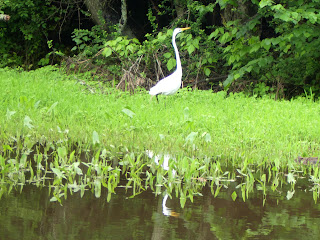
With the return to warm weather, one of our larger herons, the Great Egret , can now be found around here. Though nowhere near as common as their Great Blue Heron cousins, their size and almost completely white coloring makes them striking birds as they wade through shallow water. The yellow bill, lack of a plume, and black legs/feet differentiate it pretty well from most other heron/egret candidates, and it looks too lithe to be a Cattle Egret without breeding plumage. Another reason it's not a Cattle Egret is that it shouldn't have its non-breeding plumage right now. And finally, of the white herons in my area, by far the one I've seen this most is the Great Egret. I've mentioned before that though there seems to be a correlation between non-white herons having "heron" in their name and white herons having "egret" in their name, there's no real taxonomic distinction between the 2. In fact, the Great Egret is more closely related to the Great ...

Great Egret

Image
Here's a Great Egret foraging at the end of Duke Island Park last summer. Though a lot of egrets are white, they're really not a different type of bird from the ones called herons. So even though the Great Egret may get confused with the Snowy Egret , Cattle Egret , or Reddish Egret , they're closest relative around here is the Great Blue Heron . (There is a white morph of the Great Blue Heron found in the Florida Keys that could also be confused with a Great Egret.) You might think that a white bird would stay up north during the winter, finding camouflage during snowy periods. But these guys like things warmer, and I've never seen them in the winter. Some maps suggest they could be found in southern NJ in winter though. This bird was almost driven to extinction for its feathers; their plumes were considered quite the fashion statement in the 19th century, and the birds were hunted mercilessly. Nowadays this hunting is illegal, and although they're less common tha...

Green Heron

Image
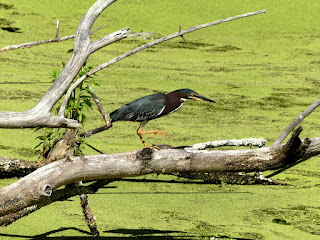
Here's a Green Heron at Duke Farms. The heron looks a little like it was stalking something, slowly approaching while focused on prey. But it was probably a false alarm; I didn't see the heron catch - or even lunge at - anything. Most herons are happy to wade in water, but the Green Heron prefers to stand outside of water when hunting for prey. I suspect this perch is a little too far above the water to allow the heron to reach the water with a strike with its beak, though other spots on this downed tree could be a perfect fishing spot for it. As I've mentioned before, there's no taxonomic difference between herons and egrets. In this area the Green Heron's closest relatives aren't the Great Blue or the Little Blue Herons, it is the Cattle Egret. (The Great Blue Heron's closest relative in this area is the Great Egret.) June 23, 2021 at Duke Farms Photo 141961334, (c) jpviolette, some rights reserved (CC BY-NC)