Posts

Showing posts with the label flower fly

Tufted Globetail

Image
Here's a Tufted Globetail from last spring. They are hoverflies in the globetail genus , which gets its name because the males have tails (actually abdomens) that end in little globes. (In this species the tail is more "thick and rounded" rather than a globe.) If this individual was a female, the abdomen would have ended in more of a point. I generally expect these flies to have more prominent black stripes on the abdomen, though I'm not sure how much variation they can have. If you were thinking this was a wasp, the hoverfly is doing its job; most hoverflies are wasp/bee mimics who "impersonate" stinging insects to get some of the protection their stinging look-alikes command. Although they can be found throughout most of North America, they're especially prevalent in Canada and the northern US. Hoverflies are also called "flower flies" (also syrphids) because as adults they're basically pollinating insects who hang around flowering plan...

Eastern Calligrapher

Image
Meet an Eastern Calligrapher , an insect I probably haven't shown you before. (At least I hope it's an Eastern Calligrapher; some of its relatives look similar.) Eastern Calligraphers are part of a very large group of insects sometimes called hover flies (the males will hover around, either defending a territory from other males or just hoping to get the attention of a female), sometimes called flower flies (the adults feed off of the nectar and pollen of flowering plants), and sometimes called  syrphid flies (pronounced SUR-fid, which appears to come from Greek and Latin words loosely meaning "descended from gnats"). These flies have a waspy look, are considered wasp mimics, and since they can't sting, they're a good example of Batesian mimicry . Notice though that as flies, they have only 1 pair of wings whereas wasps, bees, and most flying insects have 2 pairs of wings.  They're considered pollinators , though they're probably not as effective as...

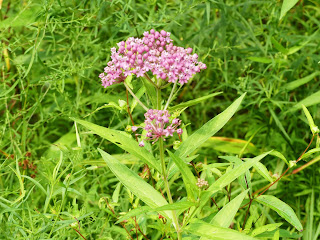
Milkweed/Dogbane Communities

Image
I was thinking recently about all the organisms that benefit from milkweed plants. (Some but not all of these also apply to dogbanes.) Just like trees support insects, birds, squirrels, and lichen as either homes or food, on a smaller scale milkweeds provide similar benefits: Perhaps their most famous connection is to Monarch butterflies, whose caterpillars feed exclusively on milkweeds (mostly leaves). They're not the only lepidopterans whose caterpillars rely on milkweeds; the Milkweed Tussock Moths also eat milkweed (and dogbane). It's not unusual to find aphids on milkweed plants. Some aphids like the Oleander Aphid are invasive, but they are insects that frequently feed on milkweed plants. And if aphids are eating milkweed, this is also likely to attract lady beetles that want to eat the aphids. Finally, the aphid poop is a sweet substance called honeydew that frequently causes Sooty Mold to grow. (I don't recall seeing aphids on dogbane, but they're documented...

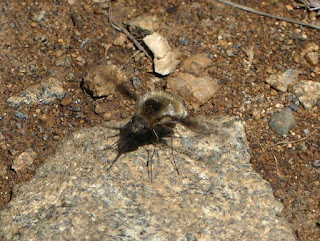
Large Bee-fly?

Image
Here's someone I met that I think I know, the Large Bee-fly . Despite the name, I wouldn't consider them to be large; they're measured in millimeters (6-12 mm). Presumably in the world of the bee flies they're relatively large, but no one who's not an entomologist is likely to say "Wow - look at the size of that thing!". I have to admit that I wasn't able to get any confirmation of the identification from iNaturalist, but the photos on Wikipedia look pretty close. And the Large Bee-fly is considered to be pretty common; it's not a stretch to imagine them at Sourland. When I took the pictures I saw them either on flowers or sunning themselves out in the open, and I suspected they might be flower flies (aka hover flies) of some sort. This would have given them an ecological niche very similar to many of our bees, competing with bees for nectar/pollen and important pollinators in their own right. Fortunately iNaturalist's picture recognition algo...