Posts

Showing posts with the label great blue heron

Red-winged Blackbirds Like Wetlands
Image
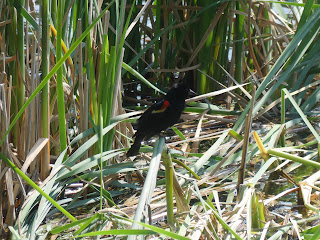
Though you'll also find them in meadows, Red-winged Blackbirds are also quite happy in a wetlands environment. It sounds like there can be insects hiding near the base of some aquatic plants, and that Red-winged Blackbirds are fairly adept at finding/eating them. And of course there are usually insects flying around near water too, some of which also potentially end up as blackbird snacks. I wouldn't be at all surprised if this Red-winged Blackbird was poking around this vegetation specifically to scare up a tasty bug. I'm sure Red-winged Blackbirds would happily eat a cooperative bluet , though I also suspect that most of the time damselflies and dragonflies are a little too quick and maneuverable to end up as a blackbird snack. As birds that like to feed near water, it should come as little surprise they're also comfortable nesting near water. The females will usually find some dense vegetation near or within water and build a nest relatively close to the ground ther...

Great Egret Striking a Pose

Image
Green Herons and Great Blue Herons weren't the only herons I spotted on this day; this Great Egret struck a pose as it waded over to its fishing spot. Since there's no taxonomic difference between herons and egrets, I'm going to claim that I hit the Heron Trifecta this day. Great Egrets are, anatomically speaking, slightly short and thin Great Blue Herons, and since the Great Blue Heron has virtually no avian predators [1], the same is probably also true of the Great Egret. If a coyote or bobcat caught 1 on land, my guess it wouldn't go well for the Great Egret. In the water, there are probably somewhat rare attacks by Common Snapping Turtles , though between scavenging and eating vegetation, snapping turtles usually find easier prey. May 25, 2023 at Duke Farms Photo 292819218, (c) jpviolette, some rights reserved (CC BY-NC) [1] It sounds like Golden Eagles will sometimes prey on Great Blue Herons but Bald Eagles rarely will. Since my area is largely devoid of Golde...

Great Blue Heron Overseeing His Lake

Image
Not far from the Green Herons , I met this Great Blue Heron intently scanning the water from its throne [1], a tree branch protruding from the water. I'm not sure if these 2 species consider themselves competitors though they're after similar food [2]. Nor have I witnessed fights or squabbles between herons even when they're both within line of sight of 1 another. While their much larger size would seem to guarantee the Great Blue Heron a victory in an altercation, fights do have consequences: Even a smaller foe could wound a bigger rival, leading to infection or impaired hunting ability. The effort/energy of fighting is effort/energy that won't be used to find food or find a mate. Especially if fish are abundant, bird calculus might indicate that peaceful coexistence is superior to conflict. May 25, 2023 at Duke Farms Photo 292818451, (c) jpviolette, some rights reserved (CC BY-NC) [1] Maybe the throne should be for a Belted Kingfisher , because of that whole "ki...

Both Blue Herons

Image
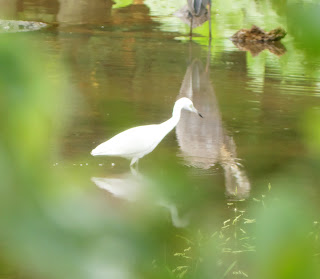
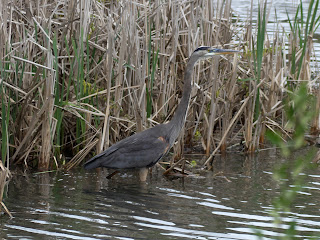
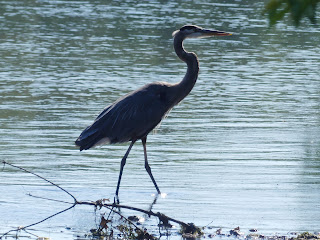
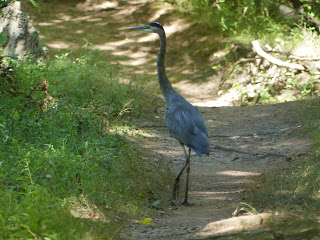
For Throwback Thursday, here's a bird I rarely encounter along with a bird I frequently encounter. The 1st 2 pictures are of a Little Blue Heron while the last picture is of a Great Blue Heron . Notice how dark all over the Little Blue Heron is, with its purple-maroon head and slaty-blue body. Wait, that's not what you're seeing? Sorry, that was a description of an adult Little Blue Heron; juveniles start out looking all white, and could be confused with a smallish Great Egret . In fact, the main reason I didn't make that mistake was because I had heard that a Little Blue Heron had been sighted here, so I was halfway to the right ID before I even saw it. Having said that, there are differences between Great Egrets and juvenile Little Blue Herons: Size: Normally I'd hesitate to even mention this since judging size from a distance can be error-prone. But in this case (see below) there was a Great Blue Heron standing nearby to use as a reference. Bill: The bill of the...

Green Heron Foraging in the Muck

Image
As they're wont to do, this Green Heron was standing outside the water; they prefer not to get their feet wet until they have to. Given the relatively shallow muddy water, I'm thinking the heron might have been hunting for frogs or crayfish more than regular fish. This is 1 of our 3 easiest-to-spot herons, and the only 1 without "great" in their name: Great Blue Heron and Great Egret . What they lack in greatness, they make up with in greenness [1]; they are a bit more colorful than those other herons [2]. May 11, 2023 at Great Swamp Photo 282421692, (c) jpviolette, some rights reserved (CC BY-NC) [1] Admittedly Green Herons aren't exactly a classic green, though it's not too far from being a midnight green . [2] I know white light is a mix of all the other colors, but us humans don't usually consider white to be particularly colorful, and so I'm claiming the Green Heron is more colorful than the Great Egret.

Heron Cousins Go Fishing

Image
Last May at Washington Valley Park I met bird cousins who were both fishing there (though not together). They were a Great Blue Heron and a Great Egret . They are usually placed in the same genus ( Ardea ); the Great Blue Heron is always placed there, though some ornithologists place the Great Egret with other white-plumaged herons. I'm going with the more mainstream classification where they're in the same genus, which makes them each other's closest relative living in New Jersey . The Great Blue Heron definitely has closer relatives elsewhere. The Grey Heron of Eurasia/North Africa is easily confused with it ... except for that different-parts-of-the-world thing. (If you think you see a Great Blue Heron on your trip to Europe, you're more likely to be seeing a Grey Heron.) They're both also considered very close relatives of Cocoi Heron of South America [1].  The Great Egret is slightly shorter, considerably lighter, and lacks the head plumes of the typical Gre...

Lone Solitary Sandpiper

Image
During the spring quite a few birds migrate through New Jersey including but not limited to shorebirds like this Solitary Sandpiper . But it's not just New Jersey that's flyover country for these birds; other than a few that overwinter in southern Texas, the lower 48 states are all basically just used during migration. This bird was no doubt hoping to get a bite to eat as it journeyed north to its mostly Canadian breeding grounds. As their name implies, they're frequently seen alone. Though they mostly eat small invertebrates, I wouldn't be surprised if things like tadpoles and small fish get eaten if the opportunity presents itself. Without a strong beak or talons to tear stuff up, they probably only eat what they can swallow whole, and their options are presumably much more limited than those of a much larger bird like a Great Blue Heron . The sandpipers are a fairly large family of birds distributed across the world and consisting of 13 genera. Many of the species d...

Are You Heron About All the Great Blues?

Image
Around here if you're around open water it's fairly likely you'll run across 1 or more Great Blue Herons . While they're certainly not as plentiful as omnivorous waterfowl like Mallards or Canada Geese , their tendency to forage alone causes them to spread out so that a lot of our wetlands have a Great Blue Heron patrolling it. One day last winter while visiting Duke Island Park/Raritan River Greenway [1] I'm pretty sure I encountered 3 of these birds. How do I know these aren't the same bird? I guess I really don't know for sure. Different posture and lighting could give a single heron 3 different looks. Still, none of these birds left on my account, so I suspect they'd have no compelling reason to leave the general area as I moved on. February 10, 2023 at the Raritan Water Power Canal Photo 263680969, (c) jpviolette, some rights reserved (CC BY-NC) February 10, 2023 at the Raritan Water Power Canal Photo 263680834, (c) jpviolette, some rights reserved...

Herons, Woodpeckers, and Pigeons

Image
Grey Heron Here's a Grey Heron I met in the spring of 2022. Some people claim that this is a species that's a rare visitor from Europe, but they're all over central New Jersey. I think I saw 4-5 of them just this week!* April 20, 2022 at Duke Farms Photo 191969839, (c) jpviolette, some rights reserved (CC BY-NC)

Great Blue Heron With a Snack

Image
Here's a Great Blue Heron I saw at Duke's Brook last autumn. I had been seeing a heron there over a span of a couple of weeks, and I'm assuming this was a favored fishing spot for a particular heron, though I have to admit I could have been seeing 2 or more different herons. In any event, this particular Great Blue Heron got what it came for, fish for a meal. Though the fish is sideways in the heron's beak, the heron will need to toss or otherwise reposition the fish so that it can be swallowed headfirst. I suspect that occasionally they'll botch the toss and the fish escapes, but herons do this sort of thing for a living and no doubt get pretty good at it. October 7, 2022 at Duke Farms Photo 249884838, (c) jpviolette, some rights reserved (CC BY-NC)

Wading Great Blue Heron

Image
I get a lot of pictures of Great Blue Herons . They're not only fairly common (at least near water) but they're also fairly large birds that stand out around lakeshores and riverbanks. So here's another one, slowly striding through shallow water looking for unwary prey. September 1, 2022 at Duke Island Park Photo 238906839, (c) jpviolette, some rights reserved (CC BY-NC)

Great Blue Herons in Myth and Legend

Image
Here's another Great Blue Heron I saw at Duke Island Park last summer. (The park was teeming with them on this day.) This one was wading through the mud and muck foraging for food. Though these big birds are ecologically interesting, herons have also sparked mankind's imagination for millennia. While the Celtic and Greco-Roman worlds had their differences (more or less settled by Roman conquest), they agreed on one thing: Herons (possibly the Gray Heron , Eurasia's Great Blue Heron look-alike) were messengers of the gods. The next time you see a heron, feel free to give them a message for Brigid , Athena , or their colleagues. (I suspect that the stature and demeanor of (some) herons seemed a little otherworldly to ancient civilizations, inspiring at connection to higher powers.) September 1, 2022 at Duke Island Park Photo 238907248, (c) jpviolette, some rights reserved (CC BY-NC)

Strolling Great Blue Heron

Image
On a trip to Duke Island Park last September I had the good fortune to encounter 8-9 Great Blue Herons (plus various turtles, damselflies, dragonflies, and butterflies). This picture of a Great Blue Heron turned out pretty good so I'll start with it. While it may look like this heron was out for a stroll down a woodland trail, the picture doesn't capture the Raritan Water Power Canal that the trail runs parallel to. Most wild animals don't have a lot of leisure time, and are usually near a perceived food source, as was the case with this heron. Perhaps it has determined that the easiest way to get from one good fishing spot to another is to take advantage of the trail that us humans have blazed [1]. September 1, 2022 at Duke Island Park Photo 238905321, (c) jpviolette, some rights reserved (CC BY-NC) [1] Of course, walking along the shore from one spot to another also has benefits; sometimes you're going to encounter a fishy or froggy menu items just walking around. An...

Great Blue Herons

Image
I meet a lot of Great Blue Herons , and these are 2 more. Although they're fairly common birds, I'm sure their size and foraging methodology also contribute greatly to the number of encounters. Note that we not only had a dry summer but also a hot one. Both these birds may have been trying to cope with the heat part. In this first picture, the Great Blue Heron may have been trying to forage in a shady spot, though I can't rule out that this could also have helped keep some human eyes off it. August 3, 2022 at Lord Stirling Park Photo 222580534, (c) jpviolette, some rights reserved (CC BY-NC) In the 2nd picture, the Great Blue Heron has waded in belly-level to the water. Once again I can't be sure of the bird's motivation; it could simply think the fishing will be better in the deeper water. August 10, 2022 at Great Swamp National Wildlife Refuge Photo 228539341, (c) jpviolette, some rights reserved (CC BY-NC)

Great Egret

Image
With the return to warm weather, one of our larger herons, the Great Egret , can now be found around here. Though nowhere near as common as their Great Blue Heron cousins, their size and almost completely white coloring makes them striking birds as they wade through shallow water. The yellow bill, lack of a plume, and black legs/feet differentiate it pretty well from most other heron/egret candidates, and it looks too lithe to be a Cattle Egret without breeding plumage. Another reason it's not a Cattle Egret is that it shouldn't have its non-breeding plumage right now. And finally, of the white herons in my area, by far the one I've seen this most is the Great Egret. I've mentioned before that though there seems to be a correlation between non-white herons having "heron" in their name and white herons having "egret" in their name, there's no real taxonomic distinction between the 2. In fact, the Great Egret is more closely related to the Great ...

Bird Watching

Image
While sometimes you're able to spot a bird and even get a decent picture of it seemingly without bothering the bird, more often than not a bird will either be flitting around, fleeing from you, or hiding from you. This occurs despite your friendly intentions towards the bird. Here's another example of what happens when a bird notices you before you notice it (in this case the bird being a Great Blue Heron ). I both regret that I've disturbed them while feeling that they displayed a wildly inaccurate threat assessment. December 17, 2021 at Duke Farms Photo 174171377, (c) jpviolette, some rights reserved (CC BY-NC)

Sandhill Cranes

Image
Though my Sibley Guide to Birds suggests they should be rarely spotted here in New Jersey, it's fairly common to see a flock of Sandhill Cranes in Franklin Township most winters. This is a species that's mostly been a bird living more in the central part of the continent, wintering in Mexico and Texas while summering in central Canada and some parts of the Midwest US. (They're named after the Sandhills of Nebraska.) But these cranes apparently didn't get the memo and are wintering with us instead.  There seems to be a lot more NJ sightings of cranes , including some apparently hybridizing with a European cousin, the Common Crane . AFAIK the cranes in Franklin aren't hybrids but pure Sandhills. From a distance these guys might give you a Great Blue Heron vibe, though the Sandhill Crane is somewhat bigger bird with a straighter neck. They're also birds that are frequently found in a flock, while Great Blue Herons live more solitary lives. And while Great Blue H...

Camera-shy Great Blue Heron

Image
While occasionally you'll run across a bird singing its heart out in plain sight, seemingly putting on a concert for you. (The concert is actually for another bird of the same species and opposite sex, but it can appear the song is for us.) But most of the time birds actually try and avoid our attention, and flee the scene like this Great Blue Heron .  All too often when I'm lurking about a shoreline, a Great Blue Heron will hear/see me before I even know it's there, like in this picture. Manually focusing on a moving target with the distance continuously changing is beyond my capabilities, so I need to rely on my camera's autofocus. In this case the heron came out a little blurry-but-recognizable; the lighting looked pretty good though. October 15, 2021 at Duke Island Park Photo 168430020, (c) jpviolette, some rights reserved (CC BY-NC)

Belted Kingfisher

Image
Here's a fairly common bird that I hear a lot, sometimes spot, but rarely get pictures of, the Belted Kingfisher . It appears to be a male since the female should have a visible chestnut colored band showing up underneath the blue band that both sexes have. That extra chestnut band makes the Belted Kingfisher one of the few birds where the females are slightly more colorful than the males. These guys are a bit larger than Blue Jays and share the Blue Jay tendency to raise an alarm call when they see a perceived threat like, but not limited to, photographers. Many times, a kingfisher will spot me and as it flies away it'll warn the herons and ducks that I'm there. Admittedly they aren't as loud/squawky as Blue Jays, but they don't make it easy to get pictures of waterfowl. From perches like this one, the Belted Kingfisher will try and spot a smallish fish, then dive into the water to catch it in its bill. Though their size and style of fishing are different, they a...

Great Egret

Image
Last summer I saw this stately looking bird strutting around the shoreline; it's a Great Egret . This is their preferred way of foraging for food, to walk along shallow water and gobble up fish. Similar to its Great Blue Heron cousin, they'll generally eat pretty much any animal small enough to swallow whole. (They don't have the tools to tear something up.) I'm not sure how well it tolerates poisonous species though, so it's possible it leaves some of our butterflies and toads alone. While wading in shallow water for food is their specialty, a hungry egret might swim after fish or even try and hover over the water and dive after one. Though the latter attempts might be done a bit awkwardly, they're better than going hungry. Did you know that there's really not a biological distinction between herons and egrets? The closest relative of the Great Egret in my area is the Great Blue Heron, and vice versa. They're both in the Ardea genus. September 18, 202...