Posts

Showing posts with the label aphid

Seven-spotted Lady Beetle

Image
Here are a couple of Seven-spotted Lady Beetles from last spring. They can be identified by their 2 (relatively) large white spots on their heads. You might think it would be easier to identify them by their 7 spots, which these 2 individuals have. Unfortunately spots on these types of beetles tends to vary. The Seven-spotted Lady Beetle usually has 7 spots but can have as many as 9 spots and as few as zero spots. I grew up calling these ladybugs while in Britain they're called ladybirds. Neither of these names are great since they are neither birds or true bugs [1]. They are a type of beetle though, so using the "lady beetle" terminology is better. (Admittedly the "lady" part of the name is still inaccurate for the males of the population, though that's an inaccuracy for another time.) June 15, 2023 at Sourland Mountain Preserve Photo 300990664, (c) jpviolette, some rights reserved (CC BY-NC) June 15, 2023 at Sourland Mountain Preserve Photo 300989540, (c)...
Margined Leatherwing Beetle

Image
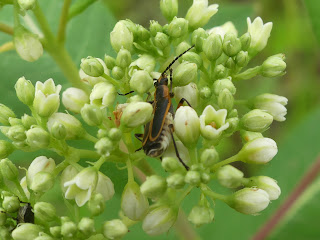
This was 1 of the Margined Leatherwing Beetles on yesterday's Hemp Dogbane . They are 1 of our more commonly seen soldier beetles , a family of beetles considered to be somewhat related to fireflies : Both are longish beetles with relatively soft elytra (the mostly protective outer wings) compared to the typical beetle. Both grow from larvae that prey on invertebrates like snails, slugs, worms, and some insects. But AFAIK none of the soldier beetles exhibit any bio-luminescent traits. The Margined Leatherwing Beetle - like its Goldenrod Soldier Beetle cousins [1] - is generally considered to be a beneficial pollinator as adults [2]. June 3, 2023 at John Clyde Native Grassland Preserve Photo 300859635, (c) jpviolette, some rights reserved (CC BY-NC) [1] Supporting their relatedness, the Goldenrod Soldier Beetle is sometimes called a Goldenrod Leatherwing Beetle while the Margined Leatherwing Beetle is sometimes called a Margined Soldier Beetle. [2] Their predatory days may not be...

Little Wood Satyr

Image
Satyrs may have started out in Greek mythology, but these days you can find them in modern lepidoptery. Here are a couple of Little Wood Satyrs I saw at 2 different locations on the same spring day. Many of the satyrines (aka "browns") abstain from nectar-feeding altogether as adult butterflies, preferring sap, rotting fruit, and other organic juices. Little Wood Satyrs break with their brethren species in this regard, and thus can sometimes be found on flowers. They're also known to feed off aphid honeydew  [1]. As caterpillars the satyrines tend to chow down on grasses and sedges; perhaps the butterfly in the 1st picture is reminiscing about a memorable meal from its childhood? Or regretting that it's now completely unable to consume blades of grass? May 18, 2023 at Fairview Farm Photo 292810726, (c) jpviolette, some rights reserved (CC BY-NC) May 18, 2023 at Willowwood Arboretum Photo 292813027, (c) jpviolette, some rights reserved (CC BY-NC) [1] Given their ta...

Short-winged Meadow Katydid

Image
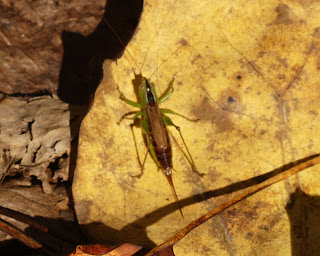
Here's an insect I don't see a lot of [1], a Short-winged Meadow Katydid . You can tell this is a female katydid (perhaps named Katie?) because of her ovipositor , the long, thin appendage at the end that she uses for laying eggs [2]. Males will attempt to woo females with a love song ; the lyrics go something like this: tick ... bzzzz ... tick-tick bzzzz ...tick ... bzzzz ... tick-tick-tick ... bzzzz It might not sound impressive to you, but if any female katydids are reading this, they're swooning right now. The katydids got their name because a different species, the Common True Katydid , sings more of a "kay-tee-did" song. (Apparently you don't have to sing a "katydid" song to be a katydid.) Katydids are usually omnivores, mostly eating vegetation but they'll spice things up once in a while by snacking on little insects like aphids . October 23, 2019 at Scherman Hoffman Wildlife Sanctuary Photo 55450643, (c) jpviolette, some rights reserved ...

Eastern Calligrapher

Image
Meet an Eastern Calligrapher , an insect I probably haven't shown you before. (At least I hope it's an Eastern Calligrapher; some of its relatives look similar.) Eastern Calligraphers are part of a very large group of insects sometimes called hover flies (the males will hover around, either defending a territory from other males or just hoping to get the attention of a female), sometimes called flower flies (the adults feed off of the nectar and pollen of flowering plants), and sometimes called  syrphid flies (pronounced SUR-fid, which appears to come from Greek and Latin words loosely meaning "descended from gnats"). These flies have a waspy look, are considered wasp mimics, and since they can't sting, they're a good example of Batesian mimicry . Notice though that as flies, they have only 1 pair of wings whereas wasps, bees, and most flying insects have 2 pairs of wings.  They're considered pollinators , though they're probably not as effective as...

Milkweed/Dogbane Communities

Image
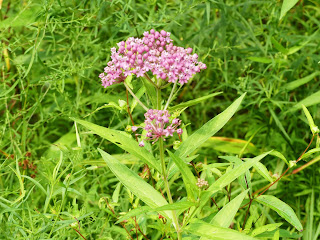
I was thinking recently about all the organisms that benefit from milkweed plants. (Some but not all of these also apply to dogbanes.) Just like trees support insects, birds, squirrels, and lichen as either homes or food, on a smaller scale milkweeds provide similar benefits: Perhaps their most famous connection is to Monarch butterflies, whose caterpillars feed exclusively on milkweeds (mostly leaves). They're not the only lepidopterans whose caterpillars rely on milkweeds; the Milkweed Tussock Moths also eat milkweed (and dogbane). It's not unusual to find aphids on milkweed plants. Some aphids like the Oleander Aphid are invasive, but they are insects that frequently feed on milkweed plants. And if aphids are eating milkweed, this is also likely to attract lady beetles that want to eat the aphids. Finally, the aphid poop is a sweet substance called honeydew that frequently causes Sooty Mold to grow. (I don't recall seeing aphids on dogbane, but they're documented...

Lady Bug and Aphids

Image
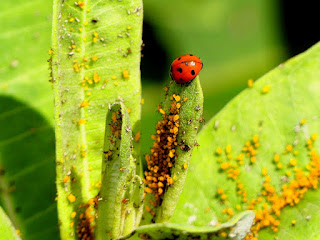
These are almost certainly invasive  Oleander Aphids (aka Milkweed Aphids) meeting their worst nightmare, a ladybug . Our milkweeds are hosts for lots of native insects (Monarch Butterflies being the most famous), but these non-native aphids not only crowd out the natives but also seem to do more damage to the milkweeds. Fortunately for us, ladybugs in particular consider aphids to be delicious. (Although I think ladybugs can eat a lot of aphids, it looks like this milkweed has more aphids than this ladybug will be able to eat.) There are a lot of similar-looking ladybugs; this one might be yet another non-native species, the Seven-spotted Ladybug . It sounds like they were intentionally introduced to the US specifically to control plant-eating insects, though as they out-compete native insects it's unclear whether they're more of a benefit or a problem.