Posts

Showing posts with the label killdeer

Thespian Killdeer

Image
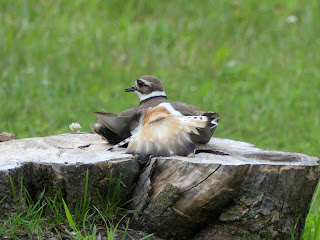
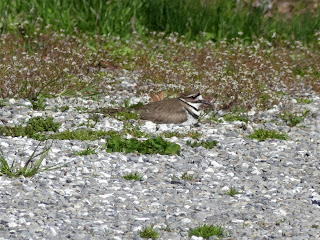
Just before leaving for home 1 day, I encountered this Killdeer that was clearly in distress, awkwardly lying on a tree stump in pain. June 29, 2023 at Sourland Mountain Preserve Photo 301252702, (c) jpviolette, some rights reserved (CC BY-NC) Fortunately Killdeer have a remarkable ability to recover from crippling injuries, and this 1 made a miraculous recovery a couple minutes later. Or was something else going on? As people familiar with Killdeer know, these birds are famous for their acting skills, and will fake an injury to lure perceived predators (like me, apparently) away from a clutch of eggs by pretending to be an injured bird the predator could make an easy meal of. Once the luring away is successful, the Killdeer then makes an improbable recovery and flies away. June 29, 2023 at Sourland Mountain Preserve Photo 301252635, (c) jpviolette, some rights reserved (CC BY-NC)

Not-So-Solitary Sandpipers

Image
Here's another couple of our Solitary Sandpiper buddies who stop by during their spring travels (AKA migration). These pictures were taken the same day and basically the same time as the Solitary Sandpiper and Lesser Yellowlegs in yesterday's post ; as I was photographing 1 I began to notice more and more shorebirds foraging in the area. Despite the solitary in the name, they will forage in the same vicinity if the pickings are good. Having said that, the sandpiper below might not have been foraging, but might be taking a break. I generally expect a typical shorebird [1] to be foraging in shallow water, though I'm sure that if a tasty invertebrate were spotted on a log, the shorebird would have no ethical or culinary qualms about eating it. May 9, 2023 at Duke Farms Photo 282305522, (c) jpviolette, some rights reserved (CC BY-NC) This next picture is "classic shorebird", standing in shallow water. The ripples centered under the bill suggest it had just poked it...
Not-so-solitary Solitary Sandpipers

Image
Last spring I saw a number of shorebirds , most of them migrating through New Jersey to get to more northerly breeding grounds [1]. On this particular day I saw a couple of Solitary Sandpipers in the same general vicinity at the same time. Although they get the "solitary" part of their name because they're frequently found alone, during migration there are probably only a limited number of good way stations available along their route. It's not shocking to see them and/or their larger Lesser Yellowlegs and Greater Yellowlegs cousins working the same area of a river even if they're not purposely flocking together. Solitary Sandpipers may prefer their alone time, but they're not psychopathic about it; these 2 were working different parts of Dukes Brook without any hostility that I could see. May 3, 2023 at Duke Farms Photo 278556645, (c) jpviolette, some rights reserved (CC BY-NC) May 3, 2023 at Duke Farms Photo 278556715, (c) jpviolette, some rights reserve...
Killdeer at a Shore

Image
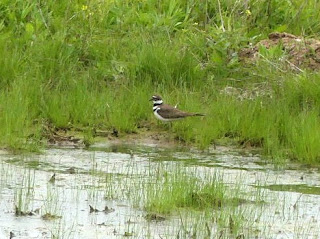
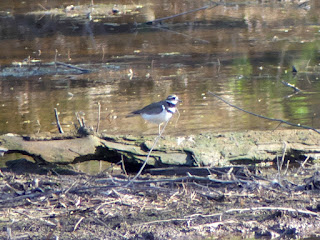
Although I frequently see Killdeer away from water, they are taxonomically shorebirds , so perhaps I shouldn't have been surprised to see one along the banks of a stream (Dukes Brook). I don't think they dislike the water, though they are fairly comfortable nesting and foraging away from it [1].  The Killdeer was spotted in April, a time when this area gets quite a few migratory shorebirds. While I'd like to think that the Killdeer was at the shore to socialize with these other shorebirds, having names like Solitary Sandpiper suggests to me that they're not the most social birds in the world. (On the other hand, it does sound like Lesser Yellowlegs will flock together, though whether that sociability extends to Killdeer is uncertain.) April 12, 2023 at Duke Farms Photo 272115395, (c) jpviolette, some rights reserved (CC BY-NC) [1] FWIW some other shorebirds seem to feel similarly.
Eastern Box Turtle

Image
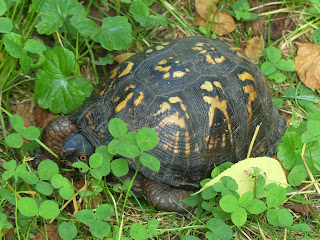
Here's a turtle that I virtually never see with other turtles, the mostly-terrestrial Eastern Box Turtle . Similar to there being shorebirds that are pretty indifferent to shores (see Killdeer ), the Eastern Box Turtle is technically a member of the pond turtle family despite living a life like that of their more distant relatives the tortoises . Their high, boxy-looking shells are responsible for their name. The Eastern Box Turtle isn't a species of turtle; it's a subspecies. The species is called the Common Box Turtle , and it comprises the EBT and 5 other subspecies. The term "box turtle" refers to a genus .  As members of the pond turtle family, EBTs can technically swim, but they don't do it well or willingly. You won't do an EBT any favors by putting it in water, but it won't be a death sentence either. If they could talk, I suspect you'd get an expletive-filled tongue-lashing from it. I found this fella when it was hiking through Research W...

Nesting Killdeer

Image
About a month ago I met a Killdeer at Duke Farms; shortly after that I noticed a pair in a gravelly parking lot there. One was in an area cordoned off by Duke Farms because there was a nest there; the other was a short distance away. I wouldn't be surprised if one of these Killdeer was 1 of the birds I had seen previously. I was a little surprised that neither Killdeer (I'm assuming they were a couple) gave me their famous "broken wing performance", where they pretend to be hurt to lure dangerous creatures away from their nest. Since this was a somewhat active parking lot, perhaps they simply got used to humans being around and decided luring us away was pointless or unnecessary. Killdeer often lay their eggs in higher parts of gravelly parking lots, right out in the open. The nests have almost no structure to them, and the only protection they have is camouflage and whatever defense their parents can provide: They're probably big enough to discourage some birds ...

Killdeer

Image
I met this Killdeer a couple weeks ago. For casual birdwatchers, these guys have a couple things you'll appreciate: You don't have to go someplace special to find them. Though taxonomically shorebirds, Killdeer aren't especially partial to the shore, and will frequently "nest" in open areas like parking lots. They're an easy ID too. Their 2 black bands around the breast are unique to other shorebirds, and probably any other birds you're likely to see around here. They're dramatic. If you accidentally get close to their nest, they'll put on an injured wing acting performance worthy of an Oscar to lure you away. (I'm assuming that their acting chops is the only reason they're able to nest out in open ground the way they do.) Though their vocalization is supposed to be calling for the execution of deer, it's unclear that they really harbor any grudge against those wild ruminants. April 2, 2022 at Duke Farms Photo 186781572, (c) jpviolett...

Killdeer

Image
Here's a Killdeer I met last month. These guys (like the Solitary Sandpiper and the Lesser Yellowlegs ) are shorebirds ... but they are shorebirds that can take the shore or leave it. They seem to like flat areas, and I'm sure they've nested in the Murray Hills parking lot where I used to work. They lay their eggs on the ground and in the open. Though the eggs do look like smooth stones, their primary protection is probably the "broken wing defense". If a predator appears, a parent will utilize their thespian skills to fake being a bird who can't fly due to a broken wing. If all goes well, the predator won't find the eggs and will attempt to stalk the "injured" Killdeer. Once the Killdeer has lured the predator sufficiently far away, that broken wing will miraculously heal and they'll fly to safety. Here's a reenactment . Though I haven't heard them a lot, they get their name from their call that sounds like "kill deer". ...