Posts

Showing posts with the label bald-faced hornet

Bluets of a Different Color
Image
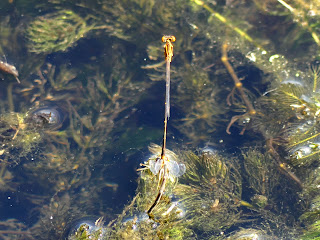
In contrast to the (frequently vividly) blue bluets I posted Wednesday and Thursday (and earlier ), I also saw a pair of  Orange Bluets  in tandem last spring. You might be thinking: "If it's orange, it should be called something else, like an oranget or something". Let me defend the name a bit: The bluets are their closest relatives, and while it's a little unfortunate that the genus was named after a trait this particular species doesn't have as adults, there are more egregious naming problems out there [1]. As you might have picked up on from the preceding bullet item, immature Orange Bluets actually are a pale blue, though they outgrow it by the time they're ready to breed. In some other species of bluet, only the males are blue. The Orange Bluet isn't the only bluet where the males are not blue either. In my area the Vesper Bluet (yellow) and the Scarlet Bluet (see if you can guess their color) are the other non-blue bluets. I suspect this partic...
Probable Bald-faced Hornet Nest

Image
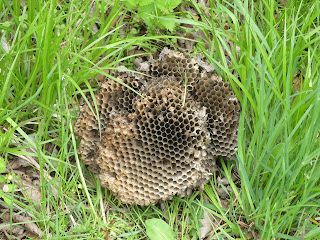
Although I didn't get iNaturalist confirmation on this, it's quite likely that this was a Bald-faced Hornet nest. They certainly build large papery nests like this , and (if I remember correctly): Common Aerial Yellowjackets build smoother looking nests. European Hornets build similar nests but usually in more sheltered locations like hollow trees. The Bald-faced Hornet builds exposed nests more likely to get blown down over a winter, and seems to be more common than the other 2. As I've mentioned in the past, Bald-faced Hornets are really a type of yellowjacket, not a type of hornet. There are 0 hornets native to North America, though there are some living here. In partial defense of the misleading name, yellowjackets and hornets look fairly similar, and there probably weren't a lot of world-class entomologist European colonists around to give them their correct name.  These nests blowing down over the winter isn't a threat to these wasps. The residents of the ...

Bald-faced Hornet

Image
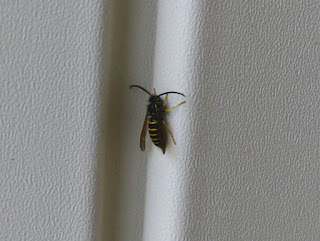
I encountered this Bald-faced Hornet - a better name would be Bald-faced Aerial Yellowjacket - last month near my apartment. It was attracted to the same tree as this European Hornet , presumably to cooking oil. I've mentioned before that these wasps aren't really hornets . I suppose they are bald, though since most wasps aren't particularly hairy "bald-faced" doesn't appear to be a very informative name. Apparently they get that part of their name the same way a Bald Eagle gets its name; they have a white face. June 10, 2022 in Finderne Photo 209835476, (c) jpviolette, some rights reserved (CC BY-NC) While I don't see these wasps a lot, I see evidence of them every autumn when the leaves fall; they are the most likely builder of the large wasp nests that were around us all summer long. (Though they'll apparently defend their nests aggressively, I think they can frequently live around us without a problem if we're not threatening their nest.) I sa...

European Hornet

Image
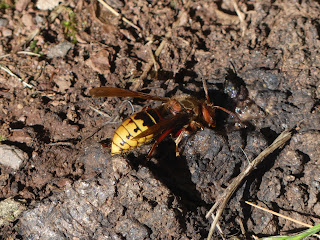
Here's someone I haven't posted about [1], an invasive insect called the European Hornet . If you're into wasps, these gals - as eusocial insects , probably every one I've ever seen was a female - are cool to look at. The rich blackish-red on most of the front of the abdomen contrasts well with the golden-yellow at the back, and they're actually big enough for you to actually see this without lens. Of course, if you've been stung, you might classify them as scary rather than good looking [2]. They are thought to have been introduced to the US (presumably accidentally) in the 1840s, and over the last 180 years they've spread throughout most of the eastern US. And they're probably not done spreading. Did you know that North America has zero native hornets? Anything you see over here named "hornet" is either: Invasive, like the European Hornet. Slightly misnamed, like the Bald-faced Hornet , which is actually an aerial yellowjacket. (Admittedly th...

Eastern Yellowjacket

Image
This is the 4th main yellowjacket species in my area and is also a native species. It's the Eastern Yellowjacket . (The other yellowjackets around here include the native Southern Yellowjacket , the (non-yellow, non-hornet) Bald-faced Hornet , and the invasive German Yellowjacket .) If you think Southern Yellowjackets are jerks, the Eastern Yellowjackets would probably agree with you. A common tactic used by Southern Yellowjacket queens when starting a new colony is to enter an existing Eastern Yellowjacket colony, attack (and if everything goes according to the SYJ's plans) kill the EYJ's queen, and usurp her role as head of the colony. This is called facultative social parasitism . (I'm assuming the existing EYJ workers don't realize they're now working for a queen of another species.) The EYJ, SYJ, and GYJ are all considered ground yellowjackets due to their normal preference to nesting in the ground (unlike their BFH cousins who are considered aerial yellow...

Bald-faced Hornet

Image
Here's someone that's certainly around central NJ (and most of the 48 contiguous states): the Bald-faced Hornet . Being closer to white than yellow, building above-ground nests, and being slightly larger than some other yellowjackets is probably why they have "hornet" in their name despite not being hornets . The other reason for the misnaming is that yellowjackets and hornets are fairly close relatives that look pretty similar. I actually looked for a good online article on the differences between yellowjackets and hornets, and most of the ones I found said things that were wrong. This video isn't scientific, but AFAIK it's accurate (though the chicken/squirrel stuff at the end is a little off topic). These wasps build many of the large papery nests that you'll frequently see hanging from trees once the leaves fall [1]. In many cases I'll find that I had been walking near their nests all summer without being harassed by them. If you're not perce...