Posts

Showing posts with the label silver-spotted skipper

Ebony Jewelwing

Image
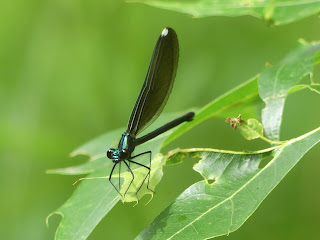
From Common Jewelweeds to Ebony Jewelwings  (not to mention Ruby-throated Hummingbirds ,  Golden-backed Snipe Flies , Great Golden Digger Wasps , and Silver-spotted Skippers ), there's treasure out in nature. These damselflies (relatives of, but not dragonflies) are likened to jewels because of the blue-to-green sheen that the males have. (Females look similar except they lack the sheen.) Odonates seem to have different preferences regarding perches. Many like low branches over water, others like hanging on reeds at/near water, a few are happy on the ground, and others seem content near to top of smallish plants. I'll frequently see Common Jewelwings on the leaves of low-hanging trees and shrubs. (Of course there are places they could be hanging out that I wouldn't notice, like if they enjoyed the top of tree canopies.) June 21, 2023 at Fairview Farm Photo 301211287, (c) jpviolette, some rights reserved (CC BY-NC)

Silver-spotted Skipper

Image
Here's 1 of our largest skipper butterflies, a Silver-spotted Skipper  [1]. For impressive-name purposes, you should pretend that the large white spot is actually silver. At least this 1 has its wings up; with the wings down  the best you could name it is a Silver-freckled Skipper (maybe). I've talked about some butterflies that don't especially like nectar and thus don't visit flowers very often (including recently ) [2]. Silver-spotted Skippers actually do like nectar but like many pollinators they're kind of picky eaters. Silver-spotted Skippers and most butterflies aren't big fans of yellow flowers, generally preferring a nice red or purple flower instead. (FWIW bees are frequently big fans of yellow flowers.) Since many related flowers have different colors, and since nectar is mostly just sugary water, I'm assuming that some animals have simply come to associate certain colors with food, and thus visit those colors more often. I'm skeptical that th...

Silver-spotted Skipper

Image
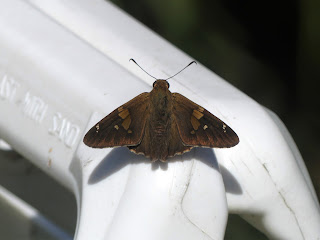
Where's the silver spot [1] on this Silver-spotted Skipper ? It's (almost certainly) there, but it's really only visible on the underside of the wing. Many times these butterflies rest with their wings held up, and their silver spot actually is a pretty prominent field mark. I don't know if this particular skipper was trying to maximize its exposure to sunlight, but it had the wings held down, and the silver spot isn't in evidence. If you only see this angle, it can make identifying this butterfly trickier. Despite this view, the silver spot gives this butterfly a reputation as the country's most recognizable skipper. [2] Most of the skippers I meet are grass skippers , where the caterpillars feed on some sort of grass. Silver-spotted Skippers are definitely not in this group; their caterpillars eat plants in the legume family like Black Locust , Honey Locust , and wisterias . (Like good children, their caterpillars eat their vegetables.) The Silver-spotted Skip...

Silver-spotted Skipper on Wild Bergamot

Image
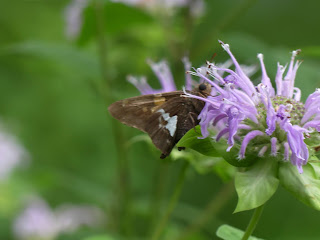
I encountered this Silver-spotted Skipper (butterfly) drinking nectar from a Wild Bergamot (mint). This is a fairly common sight. For a period of the summer, Wild Bergamot is a fairly prominent meadow wildflower, Silver-spotted Skippers are pretty common, and these skippers are attracted to colorful (blue, red, purple) wildflowers. I've talked before about Silver-spotted Skippers, so I'll mention a little about the Wild Bergamot: They're in the mint family , which also includes catnip and culinary herbs. The stems of mints tend to be squarish, to help you ID them. They're also called "bee balm", suggesting that they're popular with the bees, and thus tend to be nectar-rich. A relative, Scarlet Bee Balm , looks similar but is red. Scarlet Bee Balm doesn't seem to do well in my area - unlike Wild Bergamot I don't think I've seen it growing truly wild (though I've seen it in some Duke Farms flowerbeds where it's a little segregated from...

Silver-spotted Skipper

Image
Here's another Silver-spotted Skipper I met a couple months back. They're a moderately early season butterfly since they overwinter as pupa in a chrysalis, so they're ready to emerge as adult butterflies when the weather warms. Many of our skippers are small and predominantly brown/tan with similar markings, but these guys with their (relatively) large size and white and gold spots on a dark brown background make them distinctive/recognizable.  Common names can be confusing. If you were discussing Silver-spotted Skippers with your British lepidopterist friend, he'll be talking about this butterfly , a rare and less distinctively colored butterfly. (The two butterflies aren't considered to be particularly closely related.) May 27, 2021 at Sourland Mountain Preserve Photo 133212569, (c) jpviolette, some rights reserved (CC BY-NC)
Silver-spotted Skipper

Image
Here's the first Silver-spotted Skipper I've met this year. Though a fairly small butterfly overall, they are relatively large for a skipper butterfly. And they're fairly distinctive, mostly dark brown but with some tan and white patches on the wings. I don't think they're the most common skippers around here, though their size and coloring probably makes them the easiest ones to identify. Though the one in the picture below is kind of camouflaged, a lot of time you'll see them stand out more as they nectar on flowers. As kids (aka caterpillars) they use various legumes as host plants.  April 28, 2021 at the Plainsboro Preserve Photo 128318607, (c) jpviolette, some rights reserved (CC BY-NC)
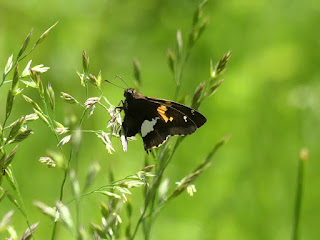
Silver-spotted Skipper

Image
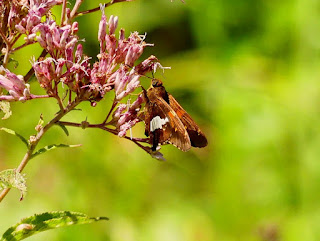
Here's a Silver-spotted Skipper I met, and it looks like it's taking advantage of the nectar from a Joe Pye Weed  wildflower. You could probably make a case for a common name of White-spotted Skipper; the large white spot on the wings inspired their name. (Admittedly "silver-spotted" sounds more prestigious than "white-spotted.) The skippers are frequently small, non-descript butterflies that probably do get mistaken for moths. The Silver-spotted Skipper is less small and less non-descript than most skippers, and are relatively common. When they're caterpillars, they spend a lot of time eating and pooping, the latter called frass . In order to prevent predators from spotting them from their frass, they're able to expel it up to 38 body lengths away. They use a variety of - but not all - legume plants as host plants when they're caterpillars. And although human agriculture grows plenty of legumes, Silver-spotted Skippers aren't considered to have...