Posts

Showing posts with the label eastern chipmunk

Eastern Wild Turkeys

Image
For Throwback Thursday - and Thanksgiving - I figured I should show a couple of the wild cousins of our Domestic Turkeys , Eastern Wild Turkeys . These 2 were selected because the pictures came out well. The 1st picture is 1 of the few pictures I've gotten of an male turkey (a tom) [1]. The prominent snood above his beak, the bright red wattle under the beak, the nearly-as-red caruncles next to the wattle, and the vicious-looking spur seen on the back of the forward leg all indicate this to be a male. (Males also have a beard, but I think the angle is wrong to see that.) June 4, 2017 at Duke Farms Photo 8423439, (c) jpviolette, some rights reserved (CC BY-NC) A little more recently I saw this female turkey (hen). Though females do have snoods (you can see it if you look closely), wattles (you should be able to see it, though it's not as prominent as the 1 on the male above), caruncles (hard to see here, maybe because of the lighting), and a leg spur (I'm told it's th...
Eastern Chipmunk Cedes the Trail

Image
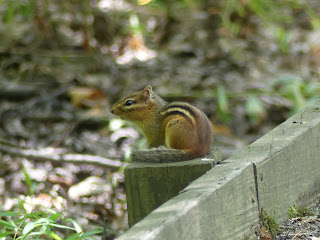
This Eastern Chipmunk decided to go off-trail when it saw me coming down said trail. Given that I weigh probably 550 times as much as the chipmunk, this would be similar to me getting out of the way of a 39 ton Humpback Whale ; even if the large animal has no ill intentions, it's not a bad idea to cede the area to avoid accidental injury. Though small and wary animals, these guys are common enough that I've gotten quite a few pictures of them. Although they're not a classic swamp creature , Great Swamp has quite a few arboreal areas adjacent to their swampier areas. I wouldn't be surprised if this particular spot floods occasionally, but it was dry enough on this visit. May 11, 2023 at Great Swamp Photo 282421831, (c) jpviolette, some rights reserved (CC BY-NC)

Standing Tall Eastern Chipmunk

Image
Here's an Eastern Chipmunk I met last autumn. Chipmunks are probably our smallest ground squirrels around here. It probably helps them scan for danger by standing on their hind legs once in a while, mitigating their small size. (Climbing on a log or rock probably works too.) I haven't seen a chipmunk yet this season, but they ought to be out and about soon. October 21, 2022 at Duke Farms Photo 250355793, (c) jpviolette, some rights reserved (CC BY-NC)

Swamp Things

Image
This summer I went to Great Swamp National Wildlife Refuge. I went there specifically to find herps (turtles, frogs, snakes), birds (herons, ducks, geese), and insects (dragonflies, damselflies, bees, wasps, butterflies). But the swamp does have lots of woods and some meadows adjacent to its murkier spots, so it's not a surprise to see non-aquatic animals in the area too. First there's this Eastern Chipmunk , a fairly commonly seen rodent at the swamp. I suspect they live here because of the forested areas around the swamp without benefiting directly from it. August 10, 2022 at Great Swamp Photo 228539724, (c) jpviolette, some rights reserved (CC BY-NC) A little later I saw an Eastern Cottontail out doing a little careful foraging. They may appreciate the edge habitats like this one. Edge habitats are areas where (for example) a meadow meets the woods. This can be a popular spot for rabbits and some birds since there's usually different plants growing in both habitats, and...

Eastern Chipmunk

Image
Here's an Eastern Chipmunk I met last autumn. The little guy was near a hollow log though it's unlikely the chipmunk lives there. Despite being skilled tree climbers, chipmunks like to live in burrows in the ground consisting of several tunnels. (It's possible there's a tunnel entrance under the log, I suppose.) Chipmunks are omnivores that primarily eat vegetation but will eat some invertebrates and even bird eggs and small bird hatchlings. It's a little difficult to describe how they spend the winter. Some sources have said they're too small to store enough body fat to hibernate through a winter, while others say they are hibernators. Maybe the key is that sometimes the term hibernation means essentially sleeping through the winter and sometimes means hunkering down in a den with food and periodically eating a meal. My guess is that Eastern Chipmunks hibernate in the sense that they mostly sleep but occasionally snack during the winter. November 4, 2021 at t...

Eastern Chipmunk

Image
Here's an Eastern Chipmunk I met. The chipmunk was unable to say hello, partly because that's not in their vocalization repertoire and partly because its mouth was full. It appears to be mostly (entirely?) leaves in the chipmunk's mouth. They don't eat leaves, so I'm assuming this is a female looking to build a nest for little baby chipmunks. If you've never seen a chipmunk nest, it's probably because you're not doing enough digging; a chipmunk nest is part of their burrow. If this is a male chipmunk, it's less clear what's going on. Maybe he lost a bet, or another chipmunk double dog dared him to put all those leaves into his mouth. (I still find the female nest-building to be the more plausible theory.) June 5, 2021 at Duke Farms Photo 136368439, (c) jpviolette, some rights reserved (CC BY-NC)

Eastern Chipmunk

Image
Here's an Eastern Chipmunk I met last month. Some people have reported an absence of chipmunks/squirrels this year. They may be reacting to an excess of these rodents the previous year. The autumn of 2019 was a mast year for oaks/acorns, which probably led to an exceptional number of these rodents (plus Blue Jays, Wild Turkeys, etc) surviving that winter and the following spring. This year was probably a much tougher year for acorn-eating species, so a drop in numbers can be expected. This little guy did survive, and appears to have found something to eat as I was taking the photograph. May 11, 2021 at Lord Stirling Park Photo 132036898, (c) jpviolette, some rights reserved (CC BY-NC)