Posts

Northern Harrier

Image
Here's another Northern Harrier . I showed you one just a couple weeks ago, but since this might be the last one I see for a while, let's show it too. While my area is around the southern edge of their breeding range , I don't think I've seen them in the summer [1]. Once again I got a distant shot of a moving harrier, so you probably can't see its somewhat owly face. (I doubt owls would agree with that description; they'd probably describe a Northern Harrier's face as "hawky".) Their genus name is Circus . Witnessing their acrobatic flights, I initially wondered if the name came from circus acrobats, but it sounds like "circus" derived from "circle" and reflects their circular flights over meadows. There are other "harrier hawks" in genus, though the Northern Harrier is the only 1 you should expect to find in North America [2]. February 21, 2023 at Duke Farms Photo 264701908, (c) jpviolette, some rights reserved (CC B...

Cardinals and Finches

Image
Here's a male Northern Cardinal dining with a female House Finch [1]. Both of these birds have stout beaks for the same reason; they both need them to crush the seeds they like to eat: Birds of a feather, flock together.   Birds of a beak, similar food they'll seek. As adults both species mostly eat fruits and seeds, though adult cardinals won't pass up a tasty mealworm . Finches are more committed to a vegetarian lifestyle, though even they won't pass up eating insects (like aphids ) that are easily accessible. The difference is much starker with what they consider baby food; cardinals will feed their hatchlings as much protein-enriched insects as they can, while finch hatchlings get primarily vegetarian meals. Despite the somewhat similar beaks, they're not particularly closely related. The Northern Cardinal is in the cardinal family (surprise!) while House Finches are in the finch family (double surprise!). Our current understanding is that cardinals are more...

Western Leaf-footed Bug

Image
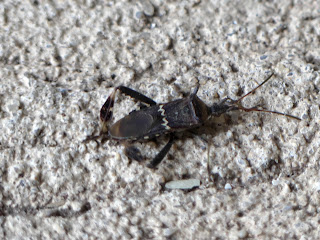
I think this was a Western Leaf-footed Bug from last February. If this is correct, then this is another species of bug that's spreading eastward. An article from a century ago claims they were no closer to New Jersey than Nebraska, the Insect Identification webpage has them in Ohio, Bug Guide lists New Jersey and Massachusetts as northeastern states they're now in, and this article abstract says they could spread as effectively as the related Western Conifer Seed Bug that's known to be in this area.  You're supposed to be able to identify the Western Leaf-footed Bug by a "spike" at the front of the head. Unfortunately my picture doesn't have enough detail to tell if such a spike is there. I'm mostly basing this ID on the iNaturalist suggested ID and Penn State describing the prominent white zigzag on the back. Although they can be pests in pistachio orchards, it sounds like these bugs are fairly flexible eaters, so there could be a viable food ...

Are You Heron About All the Great Blues?

Image
Around here if you're around open water it's fairly likely you'll run across 1 or more Great Blue Herons . While they're certainly not as plentiful as omnivorous waterfowl like Mallards or Canada Geese , their tendency to forage alone causes them to spread out so that a lot of our wetlands have a Great Blue Heron patrolling it. One day last winter while visiting Duke Island Park/Raritan River Greenway [1] I'm pretty sure I encountered 3 of these birds. How do I know these aren't the same bird? I guess I really don't know for sure. Different posture and lighting could give a single heron 3 different looks. Still, none of these birds left on my account, so I suspect they'd have no compelling reason to leave the general area as I moved on. February 10, 2023 at the Raritan Water Power Canal Photo 263680969, (c) jpviolette, some rights reserved (CC BY-NC) February 10, 2023 at the Raritan Water Power Canal Photo 263680834, (c) jpviolette, some rights reserved...

Chorus Frogs

Image
Despite the less-than-ideal photography conditions, this is most likely a Spring Peeper we met in the wetlands near the Duke Farms Orientation Center. Even if the picture doesn't capture the raw power and majesty of the inch-long Spring Peeper, it's still an excuse to talk about them. Spring Peepers are a type of chorus frog , and they have 2 relatives in New Jersey: New Jersey Chorus Frog and the Upland Chorus Frog . Their vocalizations aren't terribly different: Spring Peeper: "Peep!" New Jersey Chorus Frog: "Creek!" Upland Chorus Frog: "Creek!" "Preep!" It's surprisingly difficult to find these frogs even when you hear them singing all around you: They camouflage well. May be in water that's reflecting sunlight/flashlight glare. The ones in your immediate vicinity will sometimes go quiet when you're around them. This program was in the evening, but even in broad daylight it's much easier to hear these guys than it...

Red-bellied Woodpecker - Different Angles

Image
I've talked about Red-bellied Woodpeckers before ( people thinking they're Red-headed Woodpeckers and housing disputes with European Starlings ), so today I'm going to show different views of the same individual. This 1st view might give a person the impression that the entire head is red, perhaps leading them to believe this is a Red-headed Woodpecker. February 10, 2023 at the Raritan Water Power Canal Photo 263680633, (c) jpviolette, some rights reserved (CC BY-NC) This same individual seen from below and from the side looks quite a bit different; the red head feathers could be missed entirely. February 10, 2023 at the Raritan Water Power Canal Photo 263680618, (c) jpviolette, some rights reserved (CC BY-NC) And as birds that spend time foraging on tree branches, they'll sometimes be in awkward (from a human perspective) position while searching for food. February 10, 2023 at the Raritan Water Power Canal Photo 263680623, (c) jpviolette, some rights reserved (CC BY-...

February Turtles

Image
Since today is World Turtle Day , I'm contractually obligated to talk about turtles today. 😄🐢 Though back in April I showed you some Spiny Softshell Turtles from this year, they were not the 1st turtles I saw or photographed this year. I had actually started to see turtles basking in fairly early February, albeit only on unusually warm days. Among the first I saw were 2 of our most frequently seen basking turtles , a few Eastern Painted Turtles and a Northern Red-bellied Cooter . Though sea turtles can migrate, our turtles hibernate underwater, slowing their metabolism, and using cloacal respiration and anaerobic respiration . Anaerobic respiration sounds like what kicks in when, as the winter progresses, the water slowly becomes depleted of oxygen. While it can keep a turtle alive, it sounds like they'll experience the equivalent of muscle cramps with that form of respiration. I suspect this means that they're anxious to get out of the water to breathe as soon as the ...