Posts

Red-bellied Woodpecker
Image
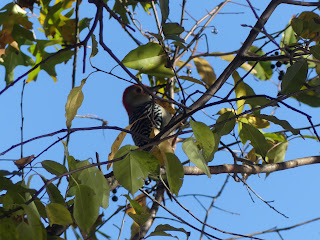
Here's a partially hidden Red-bellied Woodpecker . (Just because it has red on the head and difficult-to-see red on the belly, it doesn't make this a Red-headed Woodpecker .) Although woodpeckers are built for pecking on trees in search of invertebrates to eat, this picture probably shows one taking advantage of the berries in this tree. Though most birds love eating insects and spiders, even ones considered to be insectivores will eat nuts, acorns, seeds, and even fruits. And of course, if there happens to be an insect on that fruit too, so much the better. November 5, 2021 at the Delaware Raritan Canal Photo 169043446, (c) jpviolette, some rights reserved (CC BY-NC)

Eastern Chipmunk

Image
Here's an Eastern Chipmunk I met last autumn. The little guy was near a hollow log though it's unlikely the chipmunk lives there. Despite being skilled tree climbers, chipmunks like to live in burrows in the ground consisting of several tunnels. (It's possible there's a tunnel entrance under the log, I suppose.) Chipmunks are omnivores that primarily eat vegetation but will eat some invertebrates and even bird eggs and small bird hatchlings. It's a little difficult to describe how they spend the winter. Some sources have said they're too small to store enough body fat to hibernate through a winter, while others say they are hibernators. Maybe the key is that sometimes the term hibernation means essentially sleeping through the winter and sometimes means hunkering down in a den with food and periodically eating a meal. My guess is that Eastern Chipmunks hibernate in the sense that they mostly sleep but occasionally snack during the winter. November 4, 2021 at t...

Eastern Bluebirds

Image
In colder months finding Eastern Bluebirds seems to be feast or famine; either I won't see them at all, or I'll see 3-6 of them hanging out together. Given they look more gray than blue in my picture, I'm assuming these are females (though even the males can look gray in certain light). A century ago, the Eastern Bluebird was considered to be in danger of extinction due to loss of nesting and loss of foraging habitat. That dire consequence is past us, though Eastern Bluebird populations are still suppressed due to competition for nesting locations for these cavity nesting (bird houses or hollow trees) birds.  Apparently Eastern Bluebirds are one of the few bird species known to have had twins . Twins in birds implies that 2 birds hatch from the same egg. My suspicion is that twinning happens much more often than we know; in most cases the only way to tell is if we see N number of eggs but see N+1 number of hatchlings, and we just don't monitor every bird nest well eno...

Yellow-rumped Warbler

Image
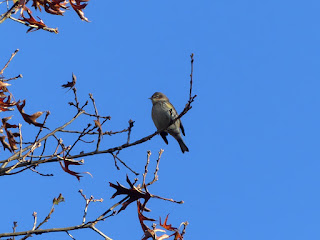
Here's a fairly well-known bird that I don't often get a picture of: the Yellow-rumped Warbler . You can actually see their famous yellow rump in the second picture. These birds mostly visit us in the winter, taking advantage of our (relatively) balmy winters (compared to their breeding range that can go pretty far north into Canada). The Yellow-rumped Warbler may not be a species soon , and this gets to the heart of what we consider a species to be. Prior to 1973 our eastern population of Yellow-rumped Warblers was called Myrtle Warblers [1], and another western population was called Audubon Warblers [2]. But then it was discovered that these 2 populations were interbreeding very readily in one range overlapping area, and so in 1973 they were grouped together into 1 species, the Yellow-rumped Warbler. But ornithologists have continued to study these birds, and have concluded that while the birds in the overlapping range have a mix of DNA between the eastern/western populations...

Dark-eyed Junco

Image
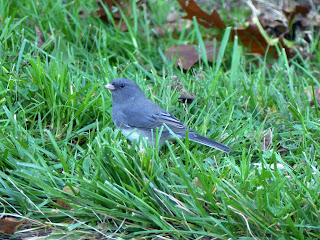
I know I showed a Dark-eyed Junco fairly recently, but this picture came out pretty good so you're getting another one. Since I did discuss them recently , I'll talk about the picture instead. In most pictures male Dark-eyed Juncos will look more like a pure gray, but this one has almost a slightly bluish look to it. I'm not sure why this is. It's possible that when I processed the photo - I take pictures in "raw" mode and then use software to create JPGs or PNGs - I accidentally changed the color, but I think it's more likely that this is a case when you can get somewhat nonstandard coloring in certain lighting. When you're trying to ID birds, flowers, insects, you probably shouldn't fixate on finding a color match since sometimes the color can look a little off. Paying attention to the shape and patterns is probably more important for many identifications. Location and season are often very important too. October 21, 2021 at Duke Farms Photo 168...

Red-eared Slider

Image
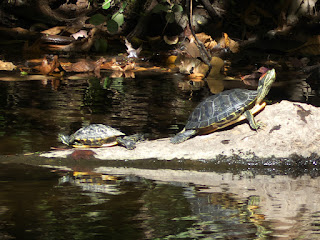
Let's show another commonly seen turtle around here: the Red-eared Slider . Most of the time this "species" can be reliably identified by ... (wait for it) ... their red "ear". Why the quotes? First, the Red-eared Slider isn't a species in its own right but is a subspecies of the Pond Slider . Second, the Pond Sliders don't have external ears, red or any other color, though the red mark is about where you'd expect an ear to be if they had external ears. There is another Pond Slider subspecies, the Yellow-bellied Slider , that I'm told is in NJ too, though I can't authoritatively say I've seen one. These turtles are popular as pets, and pets that have escaped or been released are the main reason the Red-eared Slider is an invasive animal in many parts of the US and other parts of the world. Their popularity peaked when it was revealed that the Teenage Mutant Ninja Turtles were Red-eared Sliders. As an invasive species they potentially imp...

River Cooter

Image
Here's someone that, according to my Field Guide to Reptiles and Amphibians of New Jersey, doesn't exist here: a River Cooter . For years I didn't realize these turtles were in NJ, though iNaturalist would frequently offer this as an ID for some of my pictures. Apparently this generally southern species has been in my state for decades (though perhaps in small numbers and a few localities). Their existence does complicate the turtle identification process here, especially between the cooters and the sliders. It's not entirely clear how they got here, though some form of human introduction seems most likely. Their original range was considered to be as far north as Maryland though, so a gradual natural range expansion could also be plausible. FWIW, iNaturalist does not list them as an introduced species. I have certainly encountered their relative, the Northern Red-bellied Cooter , which is listed in my field guide as NJ's largest "basking turtle" (turtles...