Posts

Eastern Pondhawk vs Blue Dasher

Image
Here's another pair of different dragonfly species sharing the same perch. (I'm not sure if it's a relatively wild blade of grass, or a long leaf from a wildflower.) The green-faced dude on the left is an Eastern Pondhawk while the white-faced guy on the right is a Blue Dasher . Though I didn't notice any fisticuffs, and I'd like to think they were friends looking for lunch together, I'd normally expect these species to be antagonistic towards one another: The Eastern Pondhawk will eat other insects approximately its size or smaller (though I suspect tangling with another predatory insect like a dragonfly is a case where they'd like to go for something smaller). The Blue Dasher males are known to act aggressively towards any other blue dragonfly, just in case they turn out to be rival males invading their territory. The Eastern Pondhawk is generally the larger of the 2, though there is overlap in their sizes. The Blue Dasher is probably more variable in siz...

The Hawk and the Sparrow

Image
I took these pictures 40 minutes apart and in somewhat different areas, so these individuals many have never met (which would be fortunate for one of them). First, here's a picture of one of our most commonly seen large birds, a Red-tailed Hawk . July 25, 2021 at Duke Farms Photo 148652475, (c) jpviolette, some rights reserved (CC BY-NC) And following that, I spotted one of our most commonly seen sparrows, a Song Sparrow . July 25, 2021 at Duke Farms Photo 148652819, (c) jpviolette, some rights reserved (CC BY-NC) There's no chance of these guys being friends, though the Red-tail probably does like Song Sparrows as a side order. My impression is that Red-tails aren't maneuverable enough to rely on catching passerines (and similarly-sized birds like woodpeckers and pigeons), though if they can get the drop on an unwary one they won't hesitate to do so. I'd expect the Red-tail to have more hunting success with rabbits, rodents, and maybe some snakes or turtles. In its...

Eastern Cottontails

Image
On this day in late July, Duke Farms was hopping with Eastern Cottontail rabbits, and here are 3 of them. One deficiency of these pictures is that you really don't get a view of their "cotton" tails. There are probably more of them around than most of us see since they're considered to be crepuscular and nocturnal , both times we have difficulties spotting and/or photographing them. These guys were seen around 9am in the morning. They're mostly herbivores, eating lots of grasses, clovers, plantains, and dandelions. They'll also feed at an accessible vegetable garden too. These are probably a little behind Gray Squirrels (very common and active during the day) and White-tailed Deer (very conspicuous) as the most commonly found wild mammals in central NJ, though Eastern Chipmunks are up there too. (I suspect that mice, shrews, and voles may have larger populations, but they're small enough that most of us don't spot them often.) July 25, 2021 at Duke F...

Eastern Calligrapher

Image
Meet an Eastern Calligrapher , an insect I probably haven't shown you before. (At least I hope it's an Eastern Calligrapher; some of its relatives look similar.) Eastern Calligraphers are part of a very large group of insects sometimes called hover flies (the males will hover around, either defending a territory from other males or just hoping to get the attention of a female), sometimes called flower flies (the adults feed off of the nectar and pollen of flowering plants), and sometimes called  syrphid flies (pronounced SUR-fid, which appears to come from Greek and Latin words loosely meaning "descended from gnats"). These flies have a waspy look, are considered wasp mimics, and since they can't sting, they're a good example of Batesian mimicry . Notice though that as flies, they have only 1 pair of wings whereas wasps, bees, and most flying insects have 2 pairs of wings.  They're considered pollinators , though they're probably not as effective as...

Monarch Wings

Image
Though these were all taken within 15 minutes of one another, it shows Monarch butterflies with various stages of wing health. First there's this individual, with perfect wings and vibrant colors. It's likely this is a relatively young individual. July 25, 2021 at Duke Farms Photo 148653086, (c) jpviolette, some rights reserved (CC BY-NC) The next Monarch seems to have intact wings, but has a more faded look. Butterfly wings have little scales on them, and when some of these are lost through normal wear and tear, their color fades. July 25, 2021 at Duke Farms Photo 148652861, (c) jpviolette, some rights reserved (CC BY-NC) Sometimes there's more tear than wear evident on butterfly wings. This individual not only looks a little faded, but has lost part of its wings. (While I long assumed the wings got torn while escaping from a predator, some butterfly watchers have said they suspect the wings are more likely torn while navigating through prickly plants.) July 25, 2021 at ...

American Goldfinches

Image
Here are a couple American Goldfinch pictures. These are males wearing their vibrant yellow-and-black plumage. Females, juveniles, and non-breeding males all have more subdued coloring. I've occasionally heard of people reporting an American Goldfinch sighting as a "escaped canary", and the Domestic Canary is somewhat related. I suspect that some people just don't think that such a colorful bird would be flying around in the wild in NJ (selectively forgetting about birds like Northern Cardinals ). These birds are considered one of the strictest vegetarians in the passerine world. While many passerines preferentially eat insects, and most will at least supplement their diet with insects, for American Goldfinches it's all about seeds. One consequence of this is that they're seldom a victim of brood parasitism by Brown-headed Cowbirds , since the cowbird nestlings can't survive on the American Goldfinch's non-insect diet. July 25, 2021 at Duke Farms Ph...

Widow Skimmer Hanging Around

Image
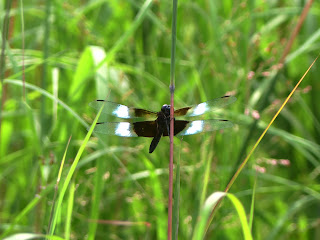
I kind of like this picture of a Widow Skimmer . Most of my dragonfly pictures are from the rear (where you get a good look at the wings and abdomen) or the side (where you get a good side view of the abdomen-to-head but the wings sometimes disappear). In this one the dragonfly is showing the wings well yet we can also get a look at the face. Of course, this does have its limitations; the white pruinose is impossible to see. If only dragonflies were vainer, perhaps they'd let me get pictures from multiple angles. July 24, 2021 at Duke Farms Photo 148594470, (c) jpviolette, some rights reserved (CC BY-NC)