Posts

Birds-foot Trefoil

Image
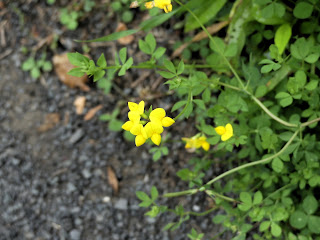
Here's another wild legume I saw a couple months ago, a Common Birds-foot Trefoil . There are some similarities to the Purple Crownvetch I talked about yesterday: They're both considered invasive in North America, and are native to Eurasia/Africa. Their flowers have a similar shape to them. They're both legumes that are sometimes used as a food source for ruminants like cows, goats, and sheep. Both have root systems that are conducive to erosion control. Note that although I suspect this is Common Birds-foot Trefoil, iNaturalist didn't give me an ID for this picture. I suspect that's because there are some other Birds-foot Trefoils that could be found around here. The leaves look wrong for this to be Narrow-leaf Birds-foot Trefoil and Horseshoe Vetch, but the difference between this and Greater Birds-foot Trefoil seems a bit more subtle (being taller and being a grayish-green in color). Lepidopterists say they rarely see butterflies on this wildflower, though the...
Purple Crownvetch

Image
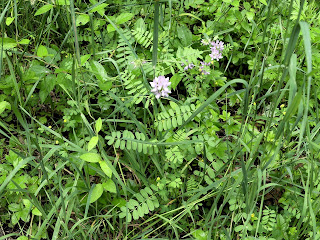
Here's a Purple Crownvetch I came across in late spring. The funky-looking light purple flowers and the pinnated leaves may get your attention, but these guys are considered fierce invaders. Native to Eurasian/Africa, these guys have tough, abundant, and deep roots that make them good at erosion control (which is why they were introduced to North America). Unfortunately they readily go beyond their erosion control mission, and can crowd out more beneficial native plants. If you talk to different herbivorous animals, they'll definitely give you different stories about this legume . Horses will warn you not to eat it since it's poisonous, but ruminants like cows and deer will tell you that it's a tasty source of protein and other nutrients. (Since us humans aren't ruminants, you probably shouldn't be grazing on this yourself.) June 11, 2021 at Washington Valley Park Photo 136371817, (c) jpviolette, some rights reserved (CC BY-NC)

American Toad

Image
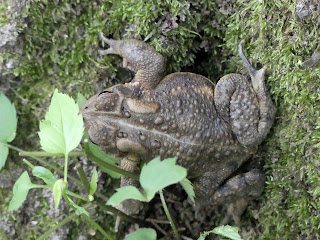
Here's an American Toad I met a couple months ago. Or at least I'm pretty sure it's an American Toad. Despite providing what looks like a pretty clear picture of the toad, nobody on iNaturalist has confirmed (or refuted) my contention that this is an American Toad. The only other contender in NJ for an ID is the Fowler's Toad . While I have better head shots of this toad, the view below is probably the one that best distinguishes its species. First I need to tell you what the parotoid glands are. These are the pair of light-colored bulges above the shoulders and behind the eyes. Overall they're probably a little smaller but longer than the toad's eyes. They store toxins that the toad can secrete to make themselves bad-tasting and somewhat poisonous. (They might be the reason we humans don't often eat toads.) Though both species of toad has parotoid glands, in the American Toad the glands do not touch the ridges behind the toad's eyes. And it looks to m...

Offshore Great Blue Heron

Image
I saw this Great Blue Heron further offshore than I usually do. I frequently see them in the water, though usually they're walking/standing just off the shore in shallow water. At the time I assumed that the water was surprisingly shallow all the way between the heron and the shore, and that the heron (probably slowly and perhaps cautiously) simply walked out there. While this interpretation is certainly plausible, I'm unsure there's a navigable walkway from there to the shore, or that the heron would be able to find such a walkway if it does exist. And I haven't known Great Blue Herons to swim; they are considered wading birds, after all. But apparently Great Blue Herons can swim if they want to, as this video and this article attest. I've seen videos of eagles and owls swimming when necessary, though they look fairly awkward doing it. At least in the video, the Great Blue Heron looks fairly natural doing it, and it even looks like they can take to flight from w...

Wood Ducks

Image
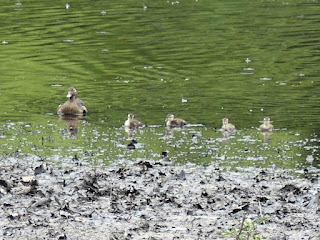
A mother Wood Duck was paddling around the Washington Valley Reservoir with ducklings about 2 months back. One problem with me blogging a couple months after taking a picture is that the ducklings probably look a lot older today; they might be adult sized by now. Still, ducklings (and goslings) are pretty photogenic. It's doubtful that this duck only hatched 4 eggs this year; my impression is that duckling mortality is pretty high, and this is just her surviving clutch. There was a Great Blue Heron around; I suspect the heron would eat a duckling if one got too close. I suspect that the ducklings are perfectly safe in deeper water though, since herons fish/hunt by wading rather than swimming. On the other hand, the mother duck didn't seem particularly concerned to see the heron in the area, and the heron didn't appear to be giving the ducklings its attention. Still, I'm sure there are life-and-death dramas surrounding the lives of these ducklings. June 11, 2021 at Was...

Find the Goose

Image
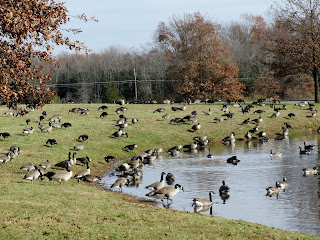
I'm doing a Throwback Thursday picture today from autumn of 2011; see if you can find the goose in this picture. 😃 At the time, this was probably the most Canada Geese I had seen in a single place. (Since then, I think a meadow at the Plainsboro Preserve had the biggest Canada Goose population I've seen.) I tried to identify a non-Canada Goose in the picture and try a where's Waldo ("where's Robby the Robin?", "where's Donald Duck?") sort of contest, but wasn't able to find any. The geese really were dominating this pond. Though these geese are too populous to be good for animal diversity here in NJ, they are kind of handsome looking birds. If they were rare, I could imagine people ooo-ing and ahh-ing over them. November 19, 20211 at Sourland Mountain Preserve Photo 11329538, (c) jpviolette, some rights reserved (CC BY-NC)

Turkey Vulture

Image
There's a spot at Washington Valley Park where I can usually find Turkey Vultures . I wouldn't be shocked if some Black Vultures hang out there too, but most of the time when I get an ID it's a Turkey Vulture that I see in this spot. Seeing a little bit of red on the head easily distinguishes this Turkey Vulture from its Black Vulture cousins. I'm not sure why this spot is popular with vultures, though I suspect it's one of the higher spots in the park and it's adjacent to grassy areas. These may combine to give the vultures a relatively good view of the landscape, possibly helping them spot a dead animal before getting airborne. And it's not the busiest part of the park, so there are relatively few of those scary humans coming by. But AFAIK it's not a hotbed of dying animals. June 11, 2021 at Washington Valley Park Photo 136371147, (c) jpviolette, some rights reserved (CC BY-NC)