Posts

Canada Goose vs Canadian Goose
Image
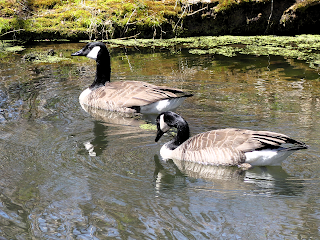
Let the Canada Goose I met at Duke Island Park segue into a talk about the name of this bird. Many people call these birds Canadian Geese, though virtually all authoritative sources use the Canada Goose term. I've heard people correct others during birdwatching programs; I'm sure there are a variety of motivations for making those corrections. Some people justify this noting the definition of " Canadian ", suggesting that unless the bird resides in Canada, the term Canadian Goose is a grammar sin. If you subscribe to that theory though, I'm assuming you would want to rename the American Robin, American Crow, European Starling, and Eurasian Collared Dove as America Robin, America Crow, Europe Starling, and Eurasia Collared Dove - but I've never heard of such an effort. Generally speaking, although I think Canada Goose is a slightly better grammatical term, there isn't a lot of consistency in the common names of birds, and you'll probably need to memo...
Wood Ducks

Image
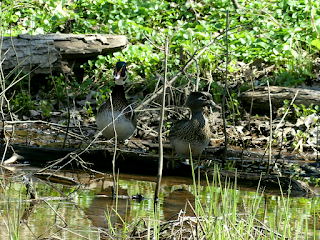
Here's a pair of Wood Ducks I met earlier in the month. I hiked from the Raritan River Greenway into Duke Island Park and was surprised to see this drake and duck hanging out pretty close to me/others. Generally I consider the Wood Duck to be fairly leery of people, and with more secluded places near the Raritan River and the Raritan Power Canal I wouldn't have expected to see them in such a small body of water in the middle of the park. My guess is they were there either because there's more food here than elsewhere, or maybe the female has found a tree cavity (or nesting box) that she's got an eye on for when she lays eggs. April 5, 2021 at Duke Island Park Photo 120291482, (c) jpviolette, some rights reserved (CC BY-NC)

Skunk Cabbage

Image
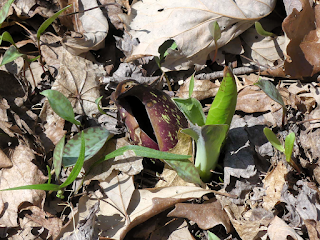
Here's some Skunk Cabbage I saw earlier this month. This is an interesting plant.  Since I have almost no sense of smell, I can't personally appreciate the smell though that's probably what it's best know for. Apparently the flower (see the non-green part in the picture below) emits the smell to attract pollinators; while you might not like the smell, pollinators know there's a feast waiting for them. If the leaves are damaged, they can also emit this odor. This might deter some animals that would like to eat their leaves, or just stomp on them to get to other food. They're a bit of a misnomer; they're neither skunks (obviously) nor cabbages (less obvious). They're in the araceae family . They are thermogenic plants ; they're able to raise their temperature higher than the surrounding environment. While most plants have to wait for the ground to thaw before appearing, the Skunk Cabbage can get the jump on most other plants by generating its own heat...

Red-eared Slider

Image
Let's try and identify more turtles. The side-to-side scute alignment clearly identifies the 2 turtles in the front and on the left as Eastern Painted Turtles . I can't see the 3rd turtle from the left as well, but I think it's also an Eastern Painted. But what about that turtle on the right? The scutes don't align, so we can rule out the Eastern Painted Turtle. I think I see a slight keel going down the carapace, and I can see a fairly prominent red mark on the head. These probably mean that this is a Red-eared Slider . Those red marks are where we'd expect ears to be, though turtles have internal ears so these aren't technically ears. These turtles are native to the US but not to NJ. They're native to an area centered around Arkansas and stretching from most of TX to western WV. They reproduce faster than most turtles, tend to be aggressive (by turtle standards), and out-compete some of our native species for food and basking spots. April 5, 2021 at Rarit...

Eagle Debate/Argument

Image
At Great Swamp , there is a bird viewing area that gives you a good view of an area of swampland (which didn't have much going on), and has a Bald Eagle nest in a tree on the opposite side of the shore. It's quite a distance, even with binoculars. (I'm sure a good spotting scope would handle the distance though.) When I went there a couple weeks ago, a couple people were listening to and (to some degree) watching a Bald Eagle confrontation. We could easily hear an eagle vocalizing. The narrative I was told was that the vocalizing was from an eagle on its nest. And there was a juvenile eagle in a nearby tree. It's unclear what the motivation of the juvenile eagle was, but the parent was obviously concerned that the juvenile could be a threat to her eaglets. You probably can't tell that that's a Bald Eagle, though the large nest probably infers one. April 14, 2021: Bald Eagle nest at Great Swamp And here's the juvenile Bald Eagle perched nearby. You can make ...

Northern Watersnakes Mating

Image
Here are pictures of Northern Watersnakes mating. (They are a subspecies of the Common Watersnake .) Generally speaking the females will grow larger than the males. I'm assuming these snake tangles all have 1 female and 1+ males. Ultimately all this romance should lead to the females giving birth to little snakelets ; Northern Watersnake females don't lay eggs but practice ovoviviparity . Though these snake babies get to meet their mother, that's generally the end of the relationship; the mother doesn't actively raise her young. In this first picture I was initially wondering if this was just one (long) snake, but eventually noticed two heads in there. April 14, 2021 at Great Swamp Photo 121032715, (c) jpviolette, some rights reserved (CC BY-NC) This seemed to be the most populated coil, with 4 different snakes tangled together. April 14, 2021 at Great Swamp Photo 121033742, (c) jpviolette, some rights reserved (CC BY-NC) Here's another pair, much less spread out. A...

Turtle Identification - Part 2

Image
After introducing some of the key things to look for in turtle identification, I want to mention the limitations of the identifications I'm doing. Most of these pictures are taken using all the magnification my camera can provide, and they still don't always provide the detail I'd like. Depending on the position of the turtle, I rarely get a view of the plastron, and if I do it's usually at the expense of a view of the carapace. If I could examine the turtle in my hands, I'd be able to do turtle identification a lot better. Having said that, the 3 middle turtles below provide a very good clue as to what they are. My field guide tells me that the Eastern Painted Turtle is the only species in NJ where "the large scutes are lined up in even rows across the carapace". From left to right, the 3rd and 4th turtles give you a good view of the scutes on the carapace lining up. These are Eastern Painted Turtles. If you look at the 2nd turtle, the scutes near the f...